Is Helmet Diving Safe? Risks, Limits And Who Should Skip It
No safety verdict is printed here because none is sourced. What the manufacturer, the operator and the booking lines do state: trained and certified guides, a briefing before the session, air fed by hose from the surface, a minimum age of 8, and a short medical advisory that names exactly who should skip it.
Short answer
Helmet diving in St Lucia runs with trained and certified guides, about 10 minutes of briefing and about 25 minutes underwater, air supplied from the surface by hose, and no swimming skill required, from age 8. The operator advises against it for pregnant travelers, those with poor cardiovascular health and those with spinal injuries.
Safety questions about helmet diving are answered here with what the manufacturer, the operator and the booking lines actually state, and nothing beyond that. If you are comparing formats as well as safety, the beginner underwater tours hub gathers the helmet walk, SNUBA and beginner scuba lines side by side.
| Fact | Detail |
|---|---|
| Format | Seabed helmet walk, no swimming required |
| Total duration | 1 hour 30 minutes |
| Briefing and walk | About 10 minutes of briefing, about 25 minutes underwater |
| Air supply | By hose from an electrically powered surface air center, constant flow of cooled, dried and filtered air |
| Guides | Trained and certified guides on every tour, per the manufacturer |
| Minimum age | 8 |
| Swimming skill | Not required |
| Operator advisory | Not recommended for pregnant travelers, travelers with poor cardiovascular health or spinal injuries |
| Cancellation | Full refund if cancelled at least 24 hours before start |
| Pickup | Included from hotels in the north of the island only |
How The Helmet Keeps You Breathing Underwater
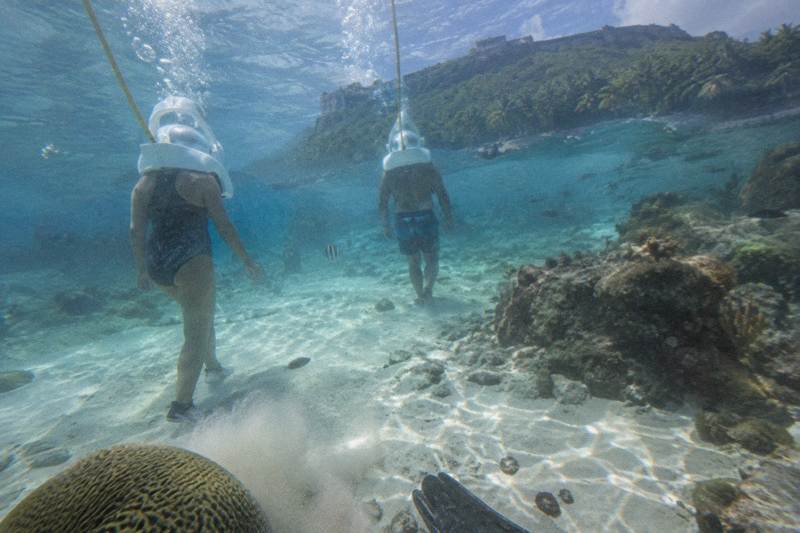
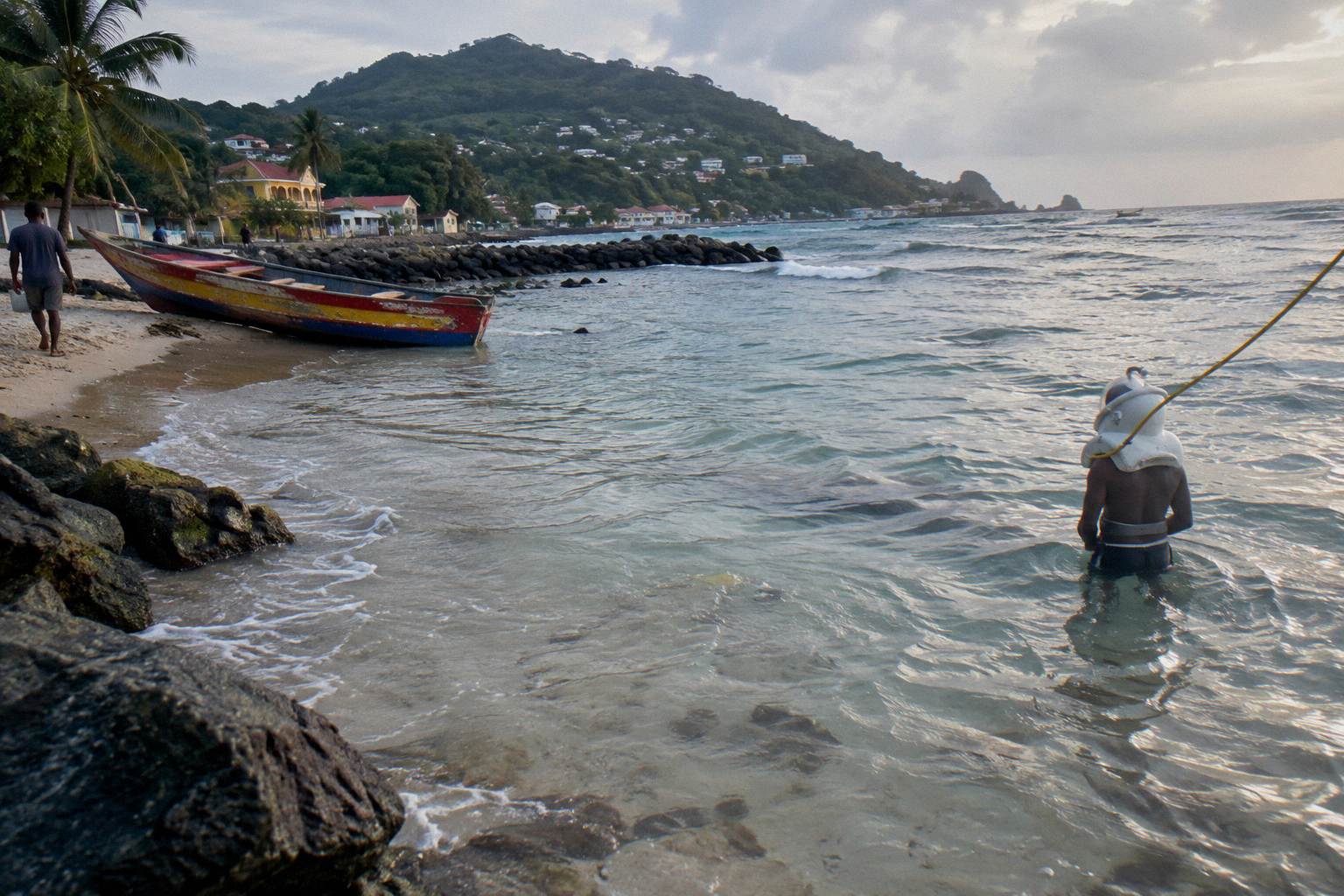
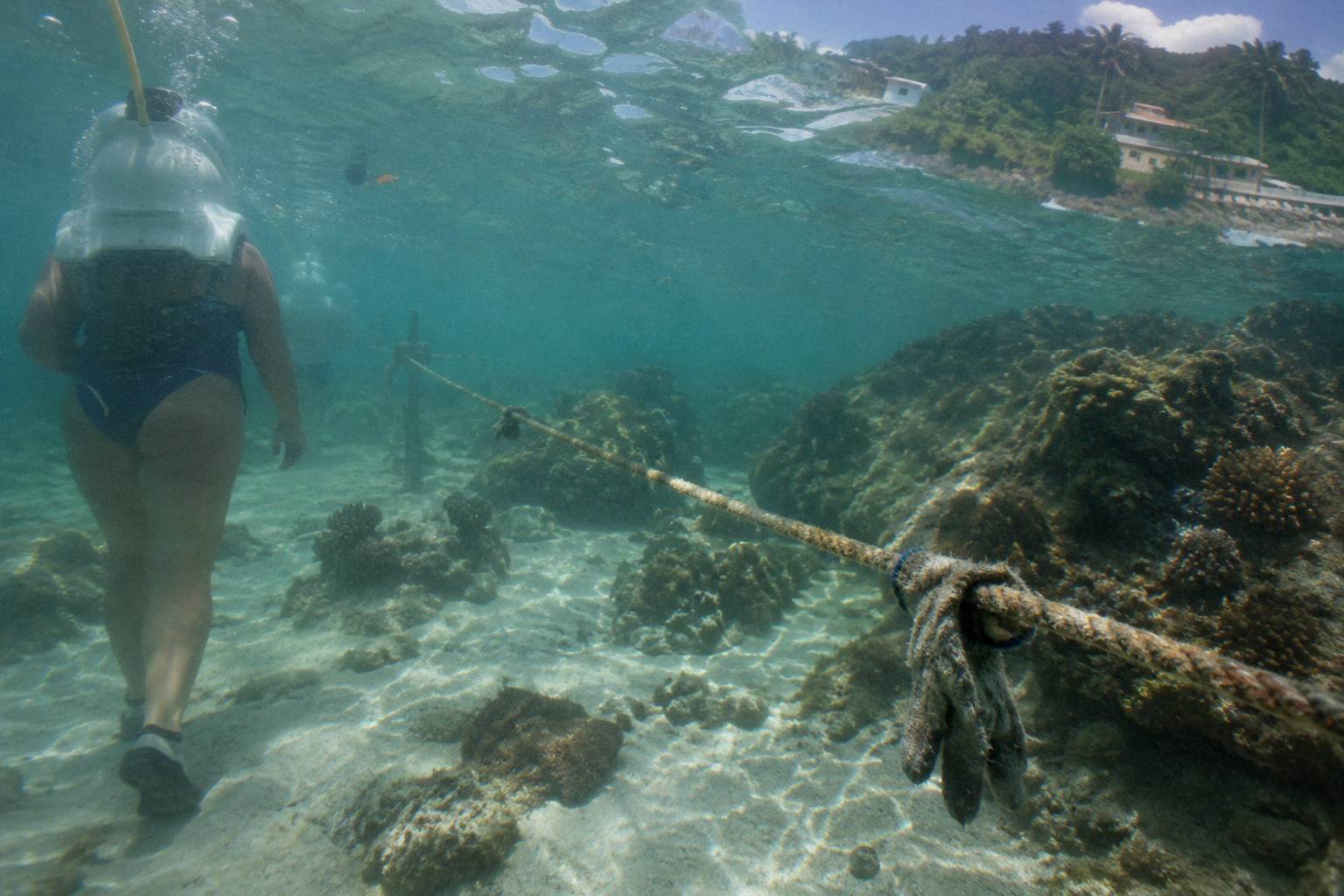
The helmet works like an inverted glass, in the manufacturer's own words: air stays inside as long as the helmet is not turned over, and a constant flow of fresh air from the surface keeps the supply turning over. That design, plus a guide beside you and a briefing before you step down, is the whole basis of the format. The manufacturer, SeaTrek maker Sub Sea Systems, describes the helmet as polycarbonate with marine-grade components and a panoramic acrylic lens, resting on your shoulders rather than clamped to your head. Air reaches the helmet through a hose from an electrically powered air center at the surface, which supplies a constant flow of cooled, dried and filtered air. In the manufacturer's phrasing you "just walk and breath," head and face stay dry, and prescription glasses can stay on.
None of that depends on you holding your breath, clearing a mask or swimming. The manufacturer states plainly that no swimming skills are required and that comfortable walking is the real prerequisite. For a fuller mechanical breakdown of the hose, the air center and how the seal behaves, read how the helmet, hose and air supply work.
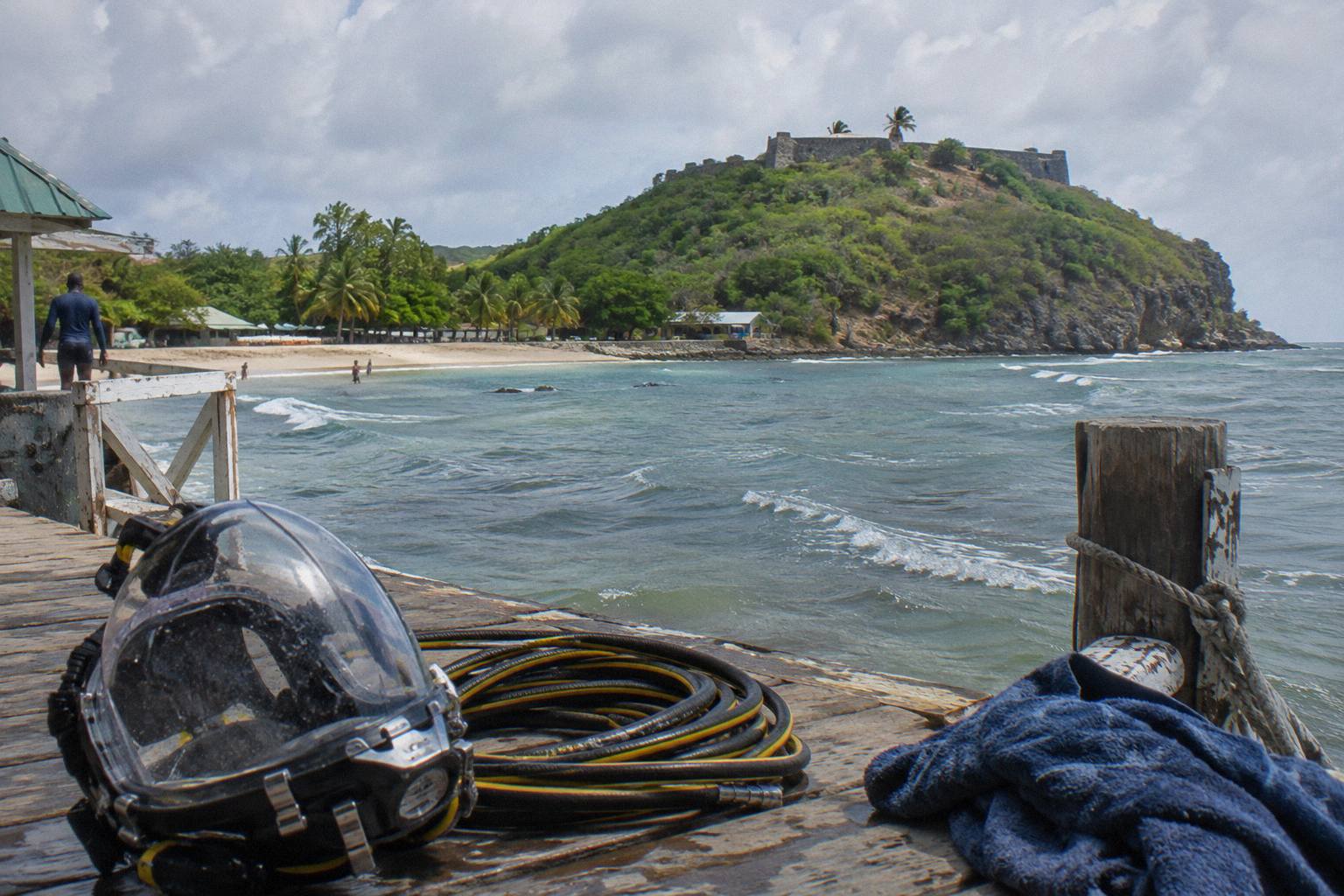
The operator, Sealife Paradise, echoes the manufacturer on its own tours page: no swimming needed, from ages 8 and up, guided experiences near the seabed off Pigeon Island. The manufacturer's SeaTrek equipment page is the primary source for the helmet's construction and the inverted-glass principle, and the operator's tours page carries the running of the sessions themselves.
The two descriptions line up on the points that matter to a nervous first-timer. The manufacturer covers the equipment and the guide certification; the operator covers the local running, the small-group promise and the free transfers within the north of the island. Neither describes the session as demanding fitness, breath control or water confidence, and both frame the walk as the activity itself. The manufacturer's age range, given as 8 to 96-plus on its own page, is a wide one, and the St Lucia booking line sets the operative floor at 8.
What The Briefing Covers Before You Step Down
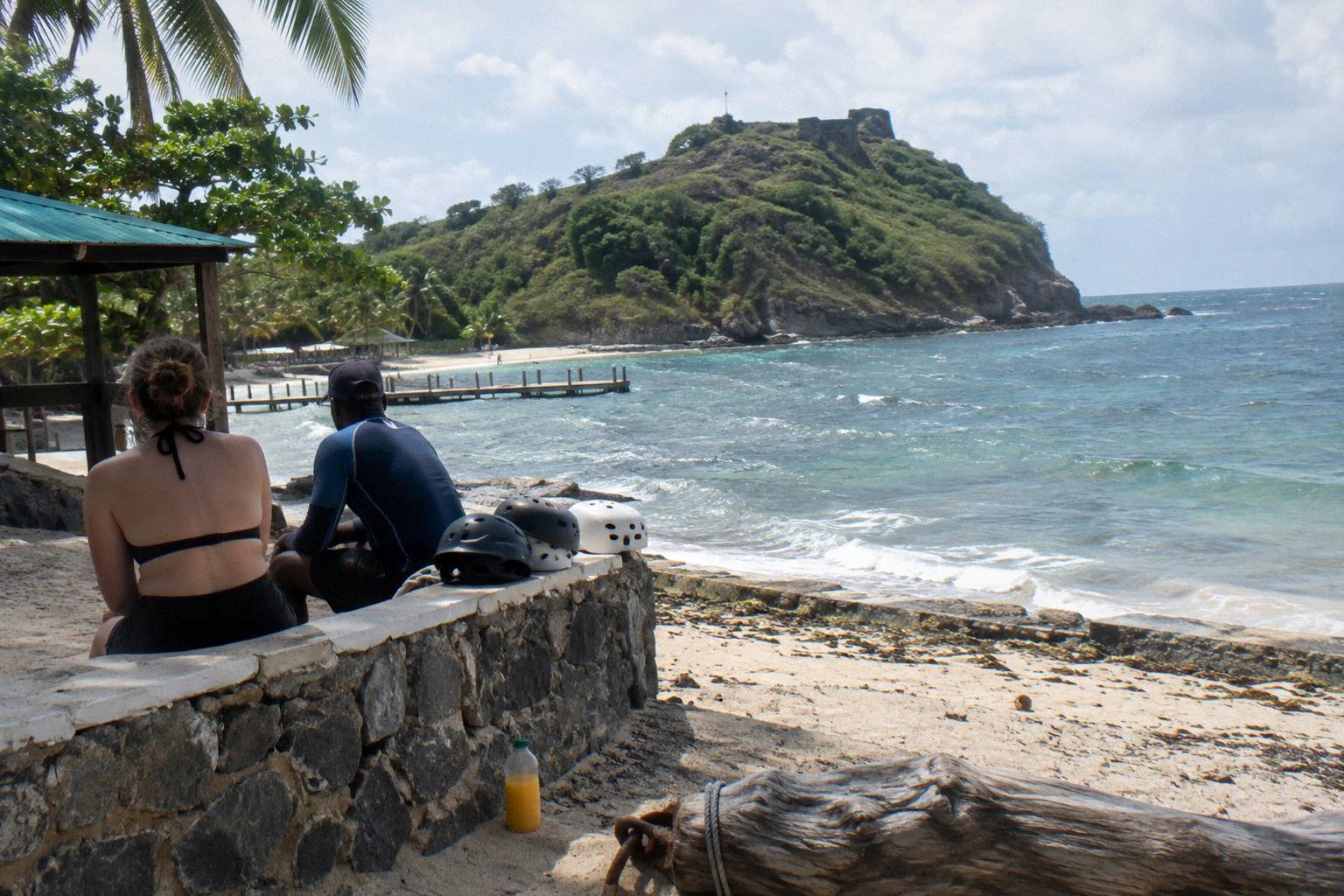
Every session begins with about 10 minutes of briefing, before roughly 25 minutes on the seabed inside the total 1 hour 30 minutes. The manufacturer states that trained and certified guides accompany every tour, so the person walking beside you underwater is the same person who prepared you on the surface. The tours on this site include the briefing as part of the session but do not itemise its contents. What is confirmed is simple: the manufacturer's "just walk and breath" framing, the operator's small-group promise, and the guide presence the manufacturer guarantees on every tour.
That is the practical answer to most nervous questions. You are not teaching yourself a skill mid-water; you are walking a prepared route with a certified guide after a short instruction period. The remaining 55 minutes or so of the 1 hour 30 minutes total covers the practicalities around the walk itself: gearing up on the beach at Pigeon Island, the transfer if you are coming from a northern hotel, and the time either side of the water. If your worry is more about breathing normally inside the helmet than about the procedure, the question is covered in full in whether you can breathe normally in a SeaTrek helmet.
A related check that belongs at the booking stage rather than the worry stage: the medical advisory. It is short, it is specific, and it is easier to read before you pay than after, so treat the booking page as part of your preparation rather than just a checkout.
Who The Operator Says Should Skip It
The operator's advisory names three groups: pregnant travelers, travelers with poor cardiovascular health, and travelers with spinal injuries. That is the complete skip list as published on the booking lines, and it applies to both the SeaTrek helmet session and the SNUBA session. Anyone outside those three flags is not excluded by the operator, and anyone inside them should ask the operator or a doctor. The advisory belongs to the operator's booking page, and it is reproduced here as that advisory rather than as medical advice. If one of the flags applies to you, the routing is simple: raise it with the operator directly, and where relevant with a doctor who knows your history, before booking.
It is worth being precise about what the advisory does not say. It sets no weight limit or height limit, none is published, and no figure is given here. It does not exclude non-swimmers; the opposite, the format is built for them. For a wider discussion of pregnancy and the same advisory wording, see medical conditions, pregnancy and helmet diving.
The advisory wording matters because it is the operator's own, not a summary. "Not recommended" is the phrase used, and it appears on both the helmet and SNUBA lines from the same operator. The same caution does not appear in the same form on the snorkeling lines, which instead carry a swimming-ability requirement; the scuba lines carry their own training and age structure. Reading each line's own conditions, rather than borrowing one line's advisory for another product, is the single most useful habit when booking any of these.
Ages, Swimming Ability And Format Compared
Minimum age splits the formats cleanly: 8 for the helmet walk and SNUBA, 6 for the beach snorkel, 4 for the boat snorkel, and 12 for both scuba lines. Swimming is not required for the helmet walk, while every snorkeling line and both scuba products state that swimming ability is needed. The helmet session, from US$118 per person with private transportation included, is the only tour among those compared that removes the swimming requirement entirely. SNUBA, from US$112 per person, keeps you on a regulator fed from a floating raft, no certification needed, with a group maximum of 14.
| Format | Minimum age | Swimming needed | Duration | From, per person |
|---|---|---|---|---|
| Seabed helmet walk | 8 | No | 1 hour 30 minutes | US$118 |
| SNUBA | 8 | See listing | 1 hour 30 minutes | US$112 |
| Beach snorkel | 6 | Yes | 1 hour 30 minutes | US$70 |
| Boat snorkel with lunch | 4 | Yes | 5 hours | US$83 |
| Beginner scuba | 12 | See listing | 5 hours | US$132 |
Amounts are US dollars, and prices vary by date and group; the booking page shows the price for your date. For swimmers weighing SNUBA against the helmet format specifically, the comparison is drawn in how SNUBA at Pigeon Island compares to a helmet dive.
The scuba lines push the age floor to 12, and both Dive Fair Helen products run 5 hours with lunch, water and juices included, pickup from northern to western island locations only. The beginner line, from US$132 per person, includes an instructor for training before the dive, one tank dive, tanks and weights, and marine fees. A first taste of scuba in St Lucia is described step by step in what a beginner scuba try dive involves.
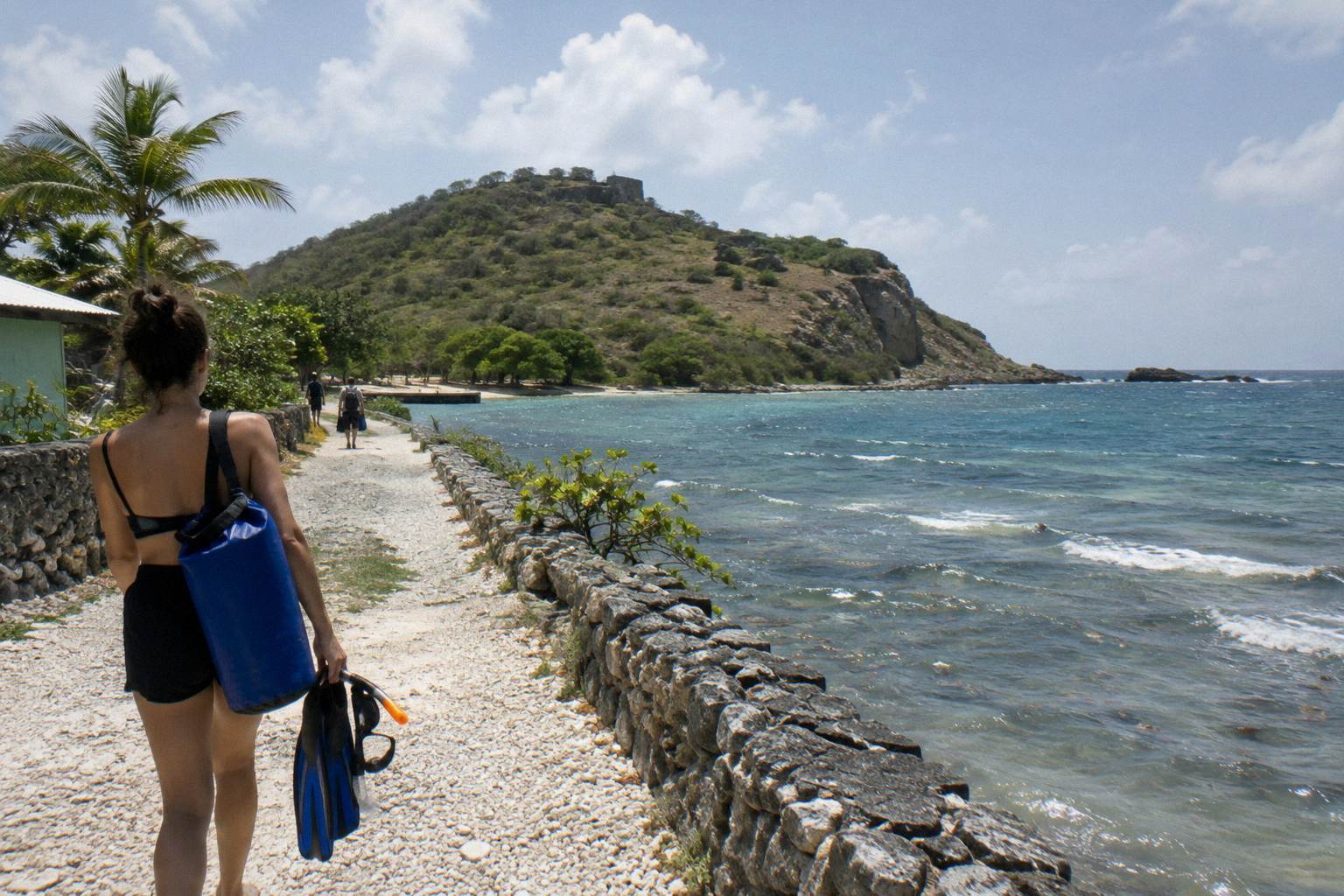
When you line the five formats up by price, the split is wide: US$70 at the low end for the beach snorkel and US$132 at the top for the beginner scuba line, a difference of US$62 per person between the cheapest and most involved option. The two mid-priced formats sit close together, with SNUBA at US$112 and the helmet walk at US$118, only US$6 apart, which makes the swimming requirement a more useful tiebreaker than price for anyone torn between them. The boat snorkel with lunch lands between the two snorkel options at US$83, though its 5 hour runtime is more than three times the 1 hour 30 minutes of the beach version, so you are paying a modest premium largely for the longer day on the water with food included.
Duration follows a similar pattern to price. Three of the five formats, the helmet walk, SNUBA and the beach snorkel, all run 1 hour 30 minutes, which suits families who want a shorter commitment or who are fitting more than one activity into a single day. The two 5 hour products, the boat snorkel with lunch and the beginner scuba line, both build a meal into the schedule, so the longer block is not all activity time. Travellers staying in the north or west of the island should also note the pickup restriction on the Dive Fair Helen scuba products, which cover northern to western locations only, while the helmet walk price includes private transportation.
Age thresholds also work as a quick sorting tool for mixed-age families. The boat snorkel with lunch is the only option open to 4 year olds, the beach snorkel starts at 6, and the helmet walk and SNUBA both require children to be at least 8. The scuba lines sit apart at 12, so households with a child between 8 and 11 can choose from four of the five formats, while a family with a 6 or 7 year old narrows to the two snorkeling lines. Because both scuba products and the snorkeling lines require swimming ability, non-swimmers of any age are effectively limited to the helmet walk, which is also the format where glasses can stay on and no certification of any kind enters the picture. SNUBA removes the certification barrier for swimmers who want a regulator experience without a course, and its group maximum of 14 gives a sense of how many people share the water with you at once.
A Who Fits Decision Table
Read your own three flags against the tours on this site: the age of your youngest, whether everyone can swim, and whether any medical advisory flag applies. The helmet walk is the only line that answers yes to age 8 and no to swimming in the same breath; every other line trades one of those away. The table below turns each tour's own eligibility lines into a single view so you can see, at a glance, which product your group can actually book rather than which one looks attractive.
| If this describes your group | The line that fits | Why |
|---|---|---|
| Ages 8 to 11, non-swimmers | Seabed helmet walk | Minimum age 8, swimming not required |
| Ages 8 to 11, confident swimmers | SNUBA | Minimum age 8, surface-fed regulator, group maximum 14 |
| Ages 6 to 7, swimmers | Beach snorkel at Pigeon Island | Minimum age 6, swimming needed, equipment included |
| Ages 4 to 5, swimmers | Boat snorkel with lunch | Minimum age 4, swimming needed, lunch and pickup included |
| Ages 12 and over, want scuba | Beginner scuba | Minimum age 12, training before the dive included |
| A pregnancy or cardiovascular flag | Ask the operator first | The advisory names pregnancy, poor cardiovascular health and spinal injuries |
One pattern worth naming: families often assume the water formats share eligibility. They do not. The gap between age 4 and age 8, or between swimmer and non-swimmer, moves you from one product line to a completely different one, and the SNUBA question is covered separately in whether SNUBA is safe for beginners.
What About Depth, Weight And Group Size
No depth limit, weight limit, height limit or group size is published for the helmet session, so none is printed here. The manufacturer gives about 15 lb as the helmet's underwater weight, its own figure and never a limit for a guest, and SNUBA's group maximum of 14 comes from that product's line alone. Gaps like these are best closed by asking the operator directly, once, before booking. The manufacturer's equipment description covers the polycarbonate shell, the panoramic acrylic lens and the shoulder-resting fit; it does not publish a session depth, and secondary reseller figures are not used here.
The helmet's out-of-water weight, about 71 lb per the manufacturer's Q&A material, is a handling detail for the crew rather than a guest requirement, and the underwater figure of about 15 lb is what the manufacturer describes as the felt result. Curious readers can follow the weight question in how heavy a SeaTrek helmet is.
The same discipline applies to group size. SNUBA carries a stated maximum of 14 travelers on its own line; the helmet line publishes no equivalent number, and no figure from another product is borrowed to fill the gap. If travelling in a large party matters to your decision, the question to ask the operator is a direct one: how many guests walk together in one session. The operator's own site promises small groups, which is a promise about approach rather than a number, and it is the operator who can turn it into one. More of these guides are collected on St Lucia Helmet Dive.
The Water, The Weather And Your Booking Checks
Two checks sit on your side of the booking: read the operator's advisory on the booking page, and ask the operator about anything it does not cover. Sea temperatures in St Lucia hold between 26 and 29 C all year, the Tourism Authority notes mornings bring the calmest water and clearest conditions, and every tour compared here offers free cancellation up to 24 hours before start. Weather, season and the operator's judgement decide what runs on a given day, and no outcome on the water is promised by anyone. The dry season runs December to April, the rainy season June to December, and the Atlantic hurricane season June 1 to November 30; planning around those windows is covered in the best time of year for underwater tours.
The Tourism Authority's beach-safety guidance applies to any day in the water: the west coast generally offers calmer waters, many beaches have no lifeguards, never snorkel alone, mind boat traffic, use reef-safe sunscreen, and never touch coral or marine life, per the Saint Lucia tourism beach safety page. The helmet session removes the swimming requirement, not the common sense.
For cruise passengers the arithmetic is tighter: sessions run from Pigeon Island with pickup from northern hotels only, and Hewanorra to Pigeon Island is about 1 hour 40 minutes per the tourism authority's Pigeon Island page. Fitting an underwater excursion into a port day is worked through in a cruise ship day in St Lucia.
If your group spans the age or swimming boundaries above, the beach snorkel at Pigeon Island, from US$70 per person with equipment and bottled water included, minimum age 6, is the line that bridges youngest swimmers; it is profiled in snorkeling at Pigeon Island National Park.
What Trips People Up Before You Book
The recurring mistakes are assuming every water format shares the same eligibility, assuming the advisory is a formality, and assuming non-swimmer status bars you from the water entirely. The tours on this site contradict all three: ages differ by product, the advisory names specific conditions, and the helmet line exists precisely for people who cannot swim. Booking the wrong line for an eight year old who cannot swim, or for a twelve year old expecting scuba, is a 24 hour cancellation window away from being fixed, but it is better fixed before payment.
The specific traps, in the order people fall into them:
- Reading the helmet line's minimum age of 8 onto the snorkel or scuba lines, whose floors are 6, 4 and 12 respectively.
- Missing that swimming ability is stated as needed on every snorkeling line, while the helmet walk states it is not required.
- Overlooking the operator's advisory against the session for pregnant travelers, travelers with poor cardiovascular health or spinal injuries.
- Expecting a published depth, weight or height limit where none exists; ask the operator instead.
- Assuming southern-hotel pickup on the northern-only lines; the scuba lines exclude southern pickup explicitly, and the Pigeon Island lines include northern hotels only.
- Forgetting the 10% per person government VAT payable at check-in on the boat snorkel line, and the excluded lunch from about US$15 per person on the private boat line.
| Mistake | What the tour details actually say | Where it bites |
|---|---|---|
| Booking SNUBA for a 6 year old | SNUBA minimum age is 8 | Beach snorkel, minimum age 6, is the younger option |
| Booking the helmet walk for a keen 10 year old swimmer who wants scuba | Beginner scuba minimum age is 12 | SNUBA or the helmet walk bridge the gap to 12 |
| Expecting pickup from Soufriere on the scuba lines | Southern pickup is excluded in named towns | Stay north or west, or arrange your own transport |
| Assuming photos come with the helmet session | Photos are not among the included items | Ask the operator before the session |
| Assuming gratuities are included | Gratuities are named as excluded on the helmet line | Budget separately |
A calm last pass before you commit: match your group's youngest age and swimming ability to the tables above, read the advisory against your own health flags, and check the live price for your date. That sequence answers more than any blanket reassurance could.
Common Questions About Helmet Diving Safety
Is Helmet Diving Safe?
No safety verdict is offered for this or any other product. The published facts: trained and certified guides on every tour per the manufacturer, about 10 minutes of briefing before about 25 minutes underwater, air supplied from the surface by hose with a constant flow, a minimum age of 8, and no swimming skill required. Ask the operator about anything beyond those facts.
Do You Need To Be Able To Swim?
No. The helmet walk tour states swimming is not required, and the manufacturer's own phrasing is that comfortable walking is what matters. Every snorkeling tour compared, by contrast, states that swimming ability is needed.
Who Should Skip Helmet Diving?
The operator's advisory names pregnant travelers, travelers with poor cardiovascular health and travelers with spinal injuries. That advisory is the operator's, printed as stated, and anyone it describes should ask the operator or a doctor before booking.
How Old Do You Have To Be?
The minimum age for the helmet walk is 8. SNUBA also starts at 8, the beach snorkel at 6, the boat snorkel with lunch at 4, and both scuba lines at 12. For a fuller look at children on the session, see the guide to age limits and kids on a SeaTrek dive.
How Does The Helmet Supply Air?
Air reaches the helmet by hose from an electrically powered air center at the surface, supplying a constant flow of cooled, dried and filtered air. The manufacturer compares the helmet to an inverted glass: the air stays in as long as the helmet is not turned over.
Can You Fly After Helmet Diving?
The published preflight surface intervals, 12 hours after a single no-decompression scuba dive and 18 hours after multiple dives or days, are DAN's scuba guidance and are printed only as that. No interval is published for helmet diving or SNUBA; ask the operator before a flight day.