Can You Breathe Normally In A Sea Trek Helmet?
How breathing works inside a Sea Trek helmet in St Lucia: the inverted glass principle, the surface air supply, and how it compares with SNUBA and scuba.
If you are weighing up the beginner underwater options around Pigeon Island, the beginner underwater tours hub gathers the helmet walk, SNUBA and beginner scuba in one place, each with its own dates and prices.
| Fact | Detail |
|---|---|
| Breathing method | Nose and mouth, no mouthpiece, no regulator |
| Air supply | Constant flow by hose from a surface air center |
| Manufacturer flow figure | About 1.6 CFM per helmet, against about 0.6 CFM used at rest |
| Air treatment | Filtered to 10 micron, dehumidified and cooled |
| Underwater time on the St Lucia walk | About 25 minutes, after about 10 minutes of briefing |
| Total duration | 1 hour 30 minutes |
| Swimming needed | No, per the manufacturer and the operator |
| Minimum age | 8 |
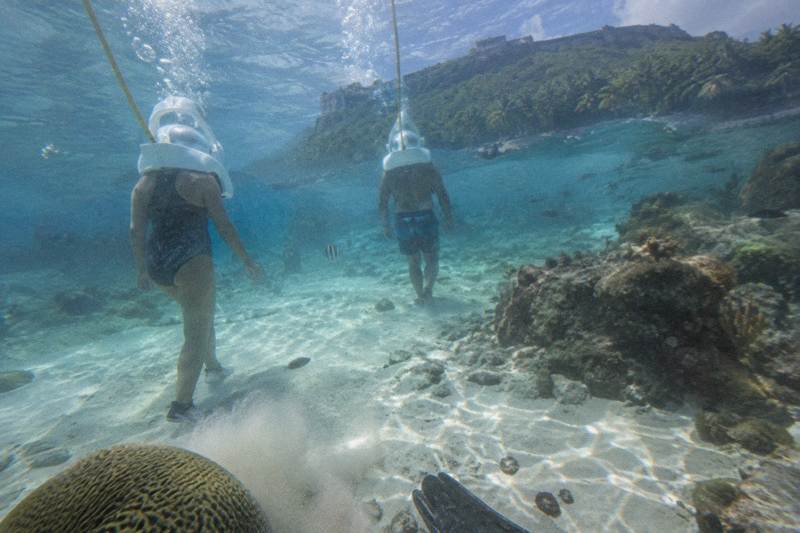
Yes, and the short explanation is that nothing about the way you breathe changes. There is no mouthpiece to clamp onto and no regulator to draw through: the manufacturer states that guests breathe through the nose and mouth as they would on land, while a hose from the surface delivers a continuous flow of air into the helmet around the head.
The phrase the operator Sealife Paradise uses on its own tours page is "breathe naturally", and the manufacturer's wording is "just walk and breath". Both are describing the same design idea: instead of carrying air on your back or sharing it from a raft, the helmet keeps a pocket of air around your head the whole time you are down. The air is not stale, either. The continuous supply creates what the manufacturer calls a fresh turnover of air inside the helmet, with the used air escaping under the bottom edge and through diffusers at the rear as new air arrives.
The full walkthrough of the equipment, including the hose and the surface unit, sits in how helmet diving works, air hose and helmet explained, which covers the same system in more depth than a single answer needs. The essentials are simple enough to state in one line: air is drawn from a clean ambient source at the surface, pushed down a hose, and delivered into a helmet that rests on your shoulders.
For readers who want to try it rather than read about it, the three products below cover the natural-breathing helmet walk, the SNUBA raft format and a full beginner scuba course with training.
Where The Air Comes From And How It Travels Down
The air starts at the surface, not on your body. An electrically powered air center draws clean ambient air, filters it to 10 micron, dehumidifies and cools it, then sends it down a hose to the helmet, where a calibrated continuous flow of about 1.6 CFM keeps the pocket of air fresh for as long as the session runs.
That flow figure deserves a plain-language translation. The manufacturer gives normal human breathing at about 0.6 CFM, roughly 17 litres per minute, while each helmet receives about 1.6 CFM, roughly 45.3 litres per minute. The supply is nearly three times what a person at rest actually uses, which is the design margin that keeps the air turning over rather than sitting still. The manufacturer describes the source air as drawn from a clean ambient supply, then filtered, dried and cooled before it travels down.
The path from surface to helmet, step by step, looks like this:
| Step | What happens | Who states it |
|---|---|---|
| 1. Air intake | Clean ambient air is drawn in at the surface | The manufacturer |
| 2. Treatment | Filtered to 10 micron, dehumidified, cooled | The manufacturer |
| 3. Delivery | Sent down a hose from an electrically powered air center | The manufacturer |
| 4. Into the helmet | A calibrated continuous flow of about 1.6 CFM per helmet | The manufacturer |
| 5. Exhaust | Used air escapes under the bottom edge and via rear diffusers | The manufacturer |
The manufacturer lists other configurations for the surface supply, including a portable pod and a backpack unit, but the St Lucia session runs on the air center setup described above. None of this requires any action from the guest. You put the helmet on, the air is already flowing, and the only job left is to walk.
The session itself is compact. The SeaTrek St. Lucia walk runs 1 hour 30 minutes in total, of which about 10 minutes is a briefing and about 25 minutes is spent underwater. Check the live price and available dates on the operator's page if the timing matters for your day.
The Inverted Glass Principle That Keeps Water Out
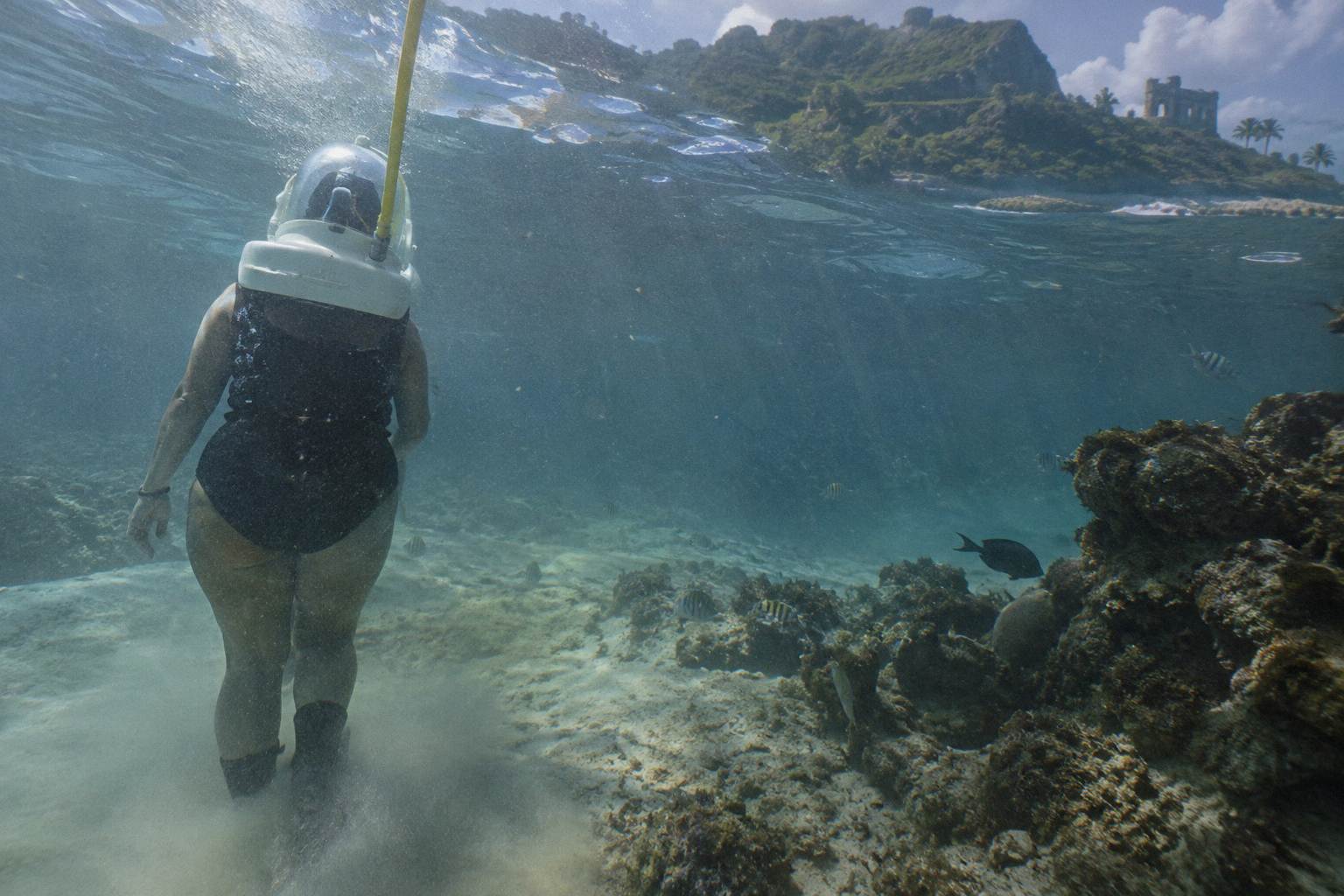
The helmet, in the manufacturer's words, works similar to an inverted glass. Push a drinking glass upside down into water and the air stays trapped inside as long as you do not tilt it; the helmet does the same thing, with the constant incoming flow keeping the water level below the chin for the whole walk.
This is the single idea that makes natural breathing possible, and it is worth understanding because it explains both what the helmet does and what it asks of you. The open bottom of the helmet sits against your shoulders. While the helmet stays upright, physics holds the air in. The continuous supply adds a slight pressure advantage, and the water line stays below your chin. The manufacturer's own summary is that head and face stay dry, which is also why prescription glasses can stay on: the manufacturer puts it plainly with "Glasses on? No problem!".
The design corollary matters too. Because the air pocket depends on the helmet not being turned over, the activity is a walk rather than a tumble or a swim. The manufacturer's line "Can't swim? No worries! Comfortable walking?" captures the trade exactly: what is asked of you is the walking part, not the swimming part. The helmet is built from polycarbonate and marine-grade components with a panoramic acrylic lens, so the view while you do it is wide rather than tunnel-like.
Two practical notes round this out. First, the manufacturer gives about 15 lb as the underwater weight of the helmet; that figure is the manufacturer's own, describing the equipment rather than a limit on any guest, and it is noticeably lighter underwater than the roughly 71 lb it weighs out of the water. Second, the operator's advisory for the helmet walk and for SNUBA is that neither is recommended for pregnant travelers, travelers with poor cardiovascular health or travelers with spinal injuries; if any of those apply, ask the operator or a doctor before booking.
If you want the fuller treatment of who should think twice, medical conditions and pregnancy on a helmet dive works through the advisory in detail.
Helmet Air Versus SNUBA And Scuba: Three Different Answers
The three beginner formats in St Lucia solve the breathing question three different ways. The helmet gives you a pocket of air with nothing in your mouth, SNUBA puts a regulator in your mouth fed from a floating raft, and beginner scuba puts a regulator in your mouth fed from a tank on your back with training beforehand.
The choice usually comes down to comfort with a mouthpiece and willingness to train. SNUBA, which the operator describes as "a cross between snorkeling and scuba diving", keeps you on a regulator throughout, with no tank on your body and no certification needed. Beginner scuba takes the training seriously: the St Lucia Beginner Scuba Diving Tour includes an instructor for training before the dive, runs a full 5 hours, and carries lunch, water and juices. The helmet walk asks for neither a mouthpiece nor a course.
| Format | How you breathe | Equipment on you | Tour product |
|---|---|---|---|
| Helmet walk | Nose and mouth, open air pocket | Helmet resting on the shoulders | SeaTrek St. Lucia, from US$118 |
| SNUBA | Through a regulator in the mouth | Regulator plus a harness, hose to a floating raft | SNUBA Saint Lucia, from US$112 |
| Beginner scuba | Through a regulator in the mouth | Full scuba set including tank and weights | St Lucia Beginner Scuba Diving Tour, from US$132 |
All amounts are US dollars, prices vary by date and group, and each booking page shows the price for the date you choose. Ratings for the three, each tied to its own product: the helmet walk carries 4.8 from 231 reviews, the SNUBA session 4.7 from 166 reviews, and the beginner scuba tour 4.7 from 57 reviews.
The SNUBA option also caps its groups at 14 travelers, runs 1 hour 30 minutes, and shares the helmet walk's minimum age of 8. Beginner scuba sets its minimum age at 12, so families with children between 8 and 11 are choosing between the first two formats. See dates on the SNUBA booking page if that side of the comparison appeals.
The scuba route has one extra planning wrinkle worth knowing early: divers answer to the flying-after-diving rules. DAN, the divers' medical body, advises a minimum preflight surface interval of 12 hours after a single no-decompression dive and 18 hours after multiple dives or multiple days of diving, because cabin altitude in commercial aircraft runs roughly 6,000 to 8,000 ft. Those intervals are scuba guidance from DAN; for the helmet walk and SNUBA, ask the operator.
What The St Lucia Session Actually Feels Like To Plan For
Plan for a short, shallow, guided walk with your head in open air. The St Lucia helmet session runs from Pigeon Island with trained and certified guides, keeps about 25 minutes underwater within a 1 hour 30 minute total, needs no swimming ability, and takes children from age 8 upward.
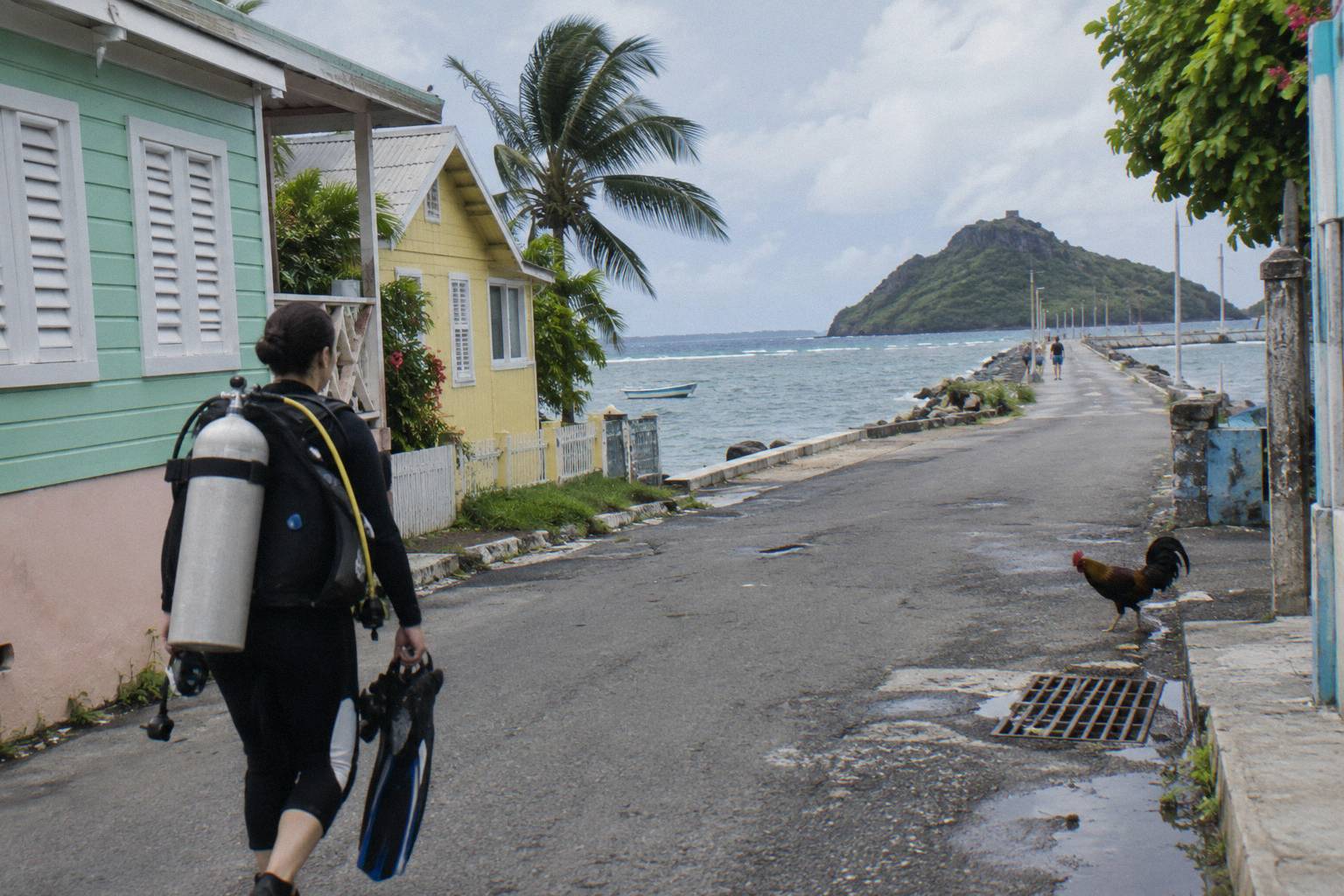
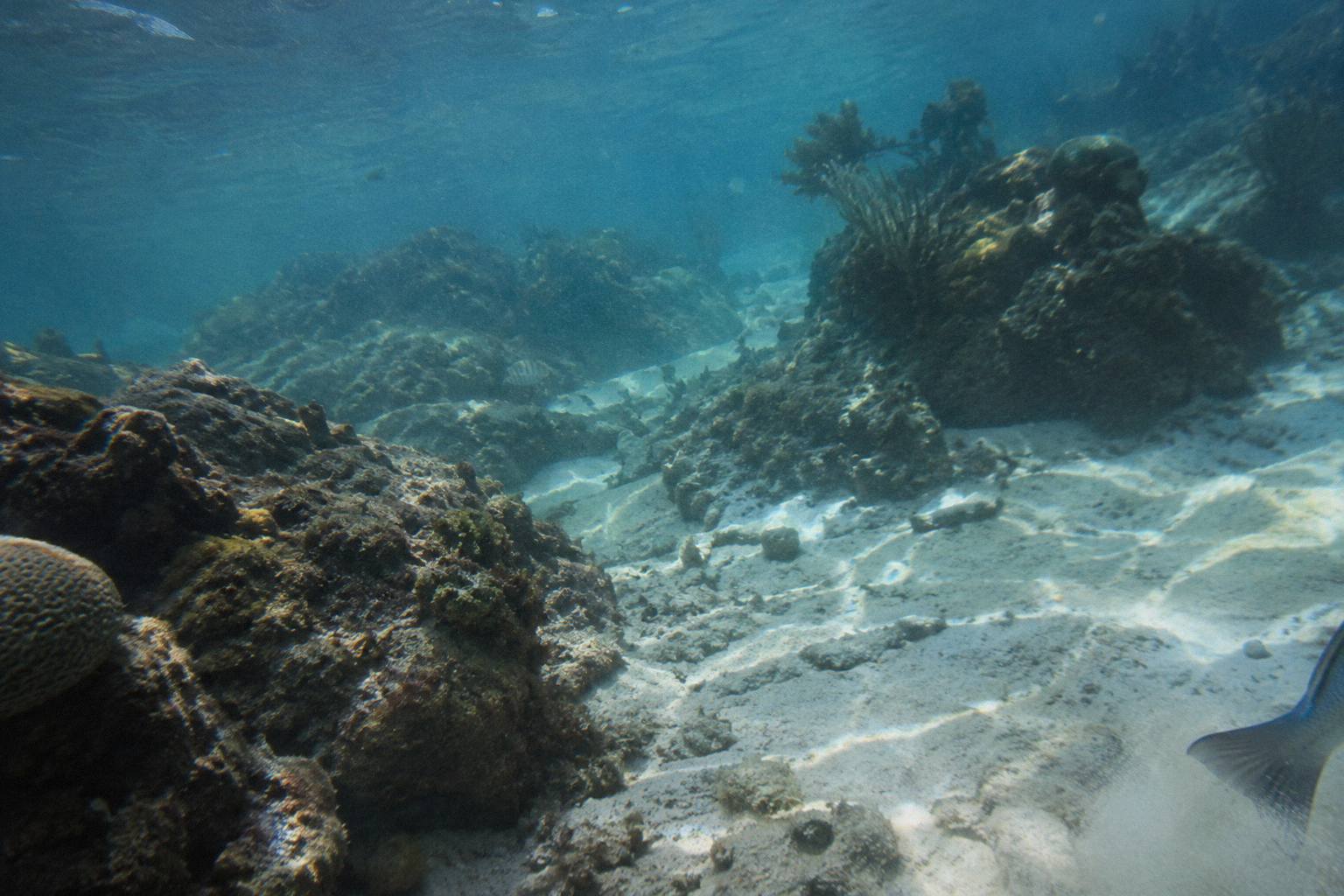
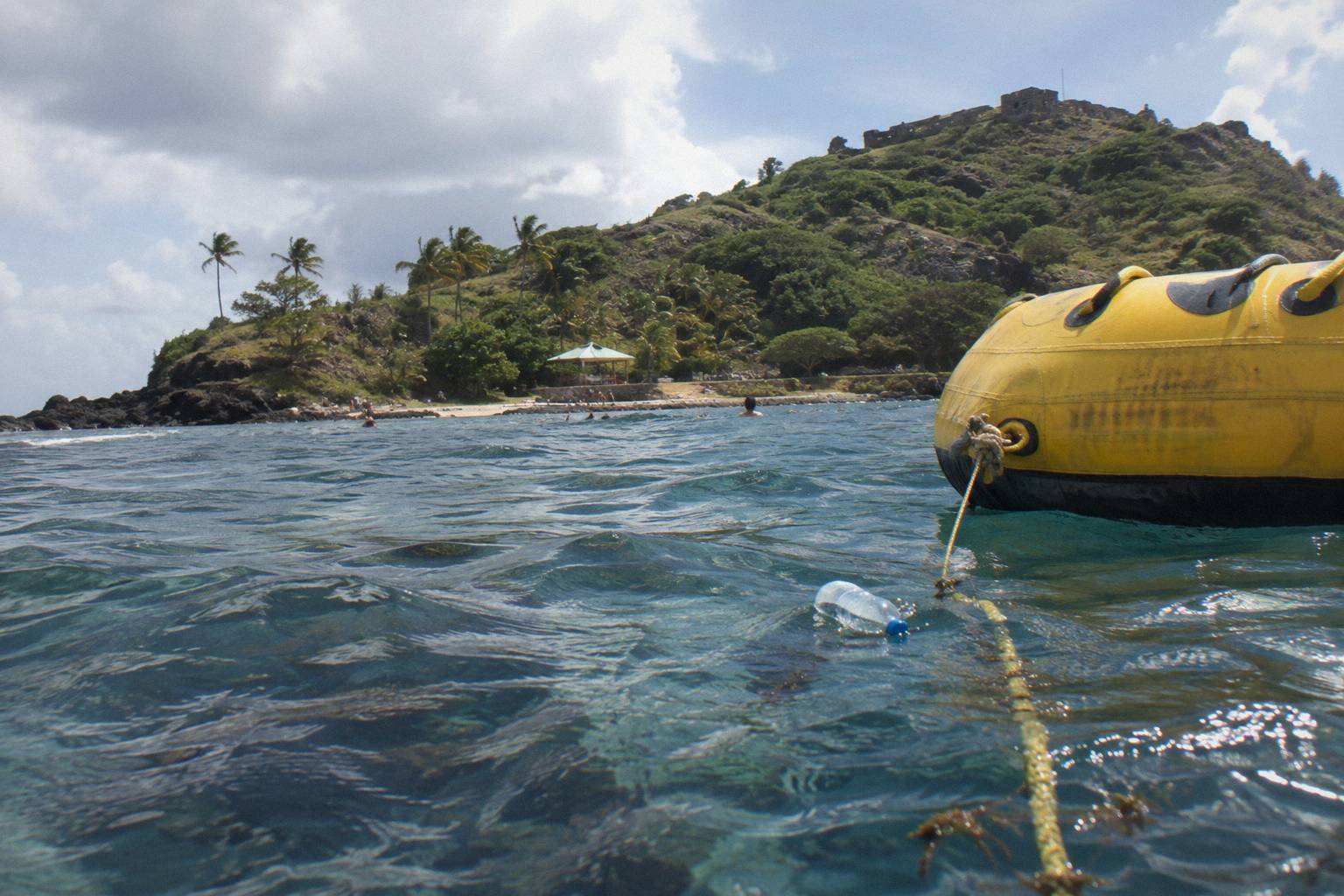
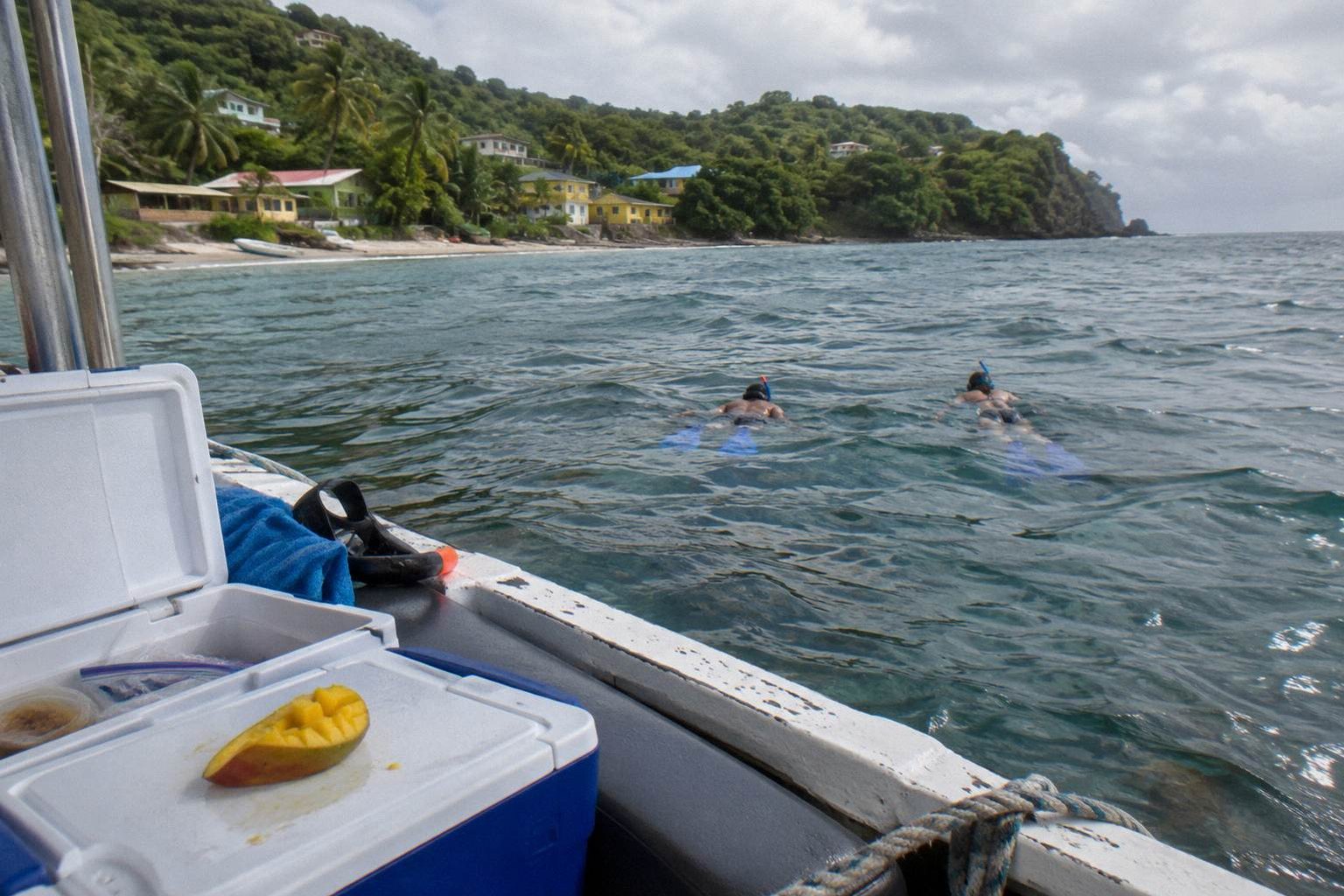
The setting matters to the comfort question more than people expect. Pigeon Island Beach, on the National Trust's 44-acre National Landmark at Gros Islet, is described by the Saint Lucia Tourism Authority as having calm sheltered waters that suit beginner snorkelers, and the helmet walk departs from that same northern corner of the island. Sea temperatures around St Lucia stay between 26 and 29 C all year, and mornings tend to bring the calmest water and clearest conditions, per the Tourism Authority's snorkeling guidance.
Logistics on the St Lucia line are simple: private transportation is included from hotels in the north of the island only, with the exact meeting point confirmed at booking, and gratuities are not included. Free cancellation applies up to 24 hours before the start, which is worth knowing if your plans depend on a flight or a cruise day. Photos are not among the included items on the product, so plan for that separately if images matter to you; the question of cameras is covered in whether you can take photos on a helmet dive.
The manufacturer's design notes also answer the questions that come up most often in families. Ages run from 8 upward, and the manufacturer's own range runs to "96+". The guides are described by the manufacturer as trained and certified on every tour. The full detail on bringing children is in age limits and kids on a Sea Trek dive, including how the minimum age compares across the snorkel and SNUBA products.
What Trips People Up Before You Book
Most of the confusion around helmet breathing comes from three mistakes: expecting a regulator, expecting a swimming test, and assuming any breathing question can be answered from scuba rules. The helmet has no mouthpiece, the manufacturer states no swimming skills are required, and the scuba flying intervals are scuba guidance only, so bring breathing or medical questions to the operator directly.
The first mistake is picturing scuba gear. People who have snorkelled imagine clamping onto a mouthpiece and breathing against a slight resistance. The helmet is the opposite arrangement: an open pocket of air at ambient conditions around your head, refreshed continuously, with nothing in your mouth at all. The manufacturer's phrase "just walk and breath" is a fair summary of the physical ask.
The second is assuming a swim requirement. The tours on this site are explicit that swimming is not required for the helmet walk, and the manufacturer says the same. Compare that with the snorkel and boat products at the other end of the spectrum, which all list swimming ability as a requirement, and the boundary is clear: if swimming is the barrier, the helmet format is the one designed around it. The non-swimmers guide to helmet diving covers what to expect in that case.
The third is borrowing scuba rules. The DAN surface intervals exist because scuba divers absorb nitrogen from compressed air at depth under pressure. Nothing in DAN's published guidance extends those intervals to surface-supplied helmet walking or to SNUBA, so the correct move is a single one: ask the operator before you plan a flight on the same day. St Lucia Helmet Dive keeps the booking links current so the dates and prices you see are the live ones, but medical questions always go to the operator or a doctor.
One last trip hazard is seasonal. The rainy season runs June to December and hurricane season runs June 1 to November 30, while the busiest and driest stretch is December to April. None of that predicts a given day, and weather decisions belong to the operator, but booking with the 24 hour free cancellation window in mind gives you room if a morning turns wet.
Choosing Between The Three If Breathing Comfort Is The Deciding Factor
If the idea of a mouthpiece is the thing holding you back, the helmet walk is the format built for you. If a mouthpiece is fine but a tank on your back is not, SNUBA splits the difference. If you want the full scuba experience with training, lunch and a 5 hour day, the beginner course at Marigot Bay is the one that delivers it.
Put plainly: the breathing question is really a mouthpiece question, and only one of the three products answers it with "no mouthpiece at all". The helmet walk, SeaTrek St. Lucia, runs from Pigeon Island in the north, from US$118 per person, with pickup from northern hotels included. The SNUBA session from the same departure point runs from US$112 per person with equipment included and water provided after. The beginner scuba tour from Marigot Bay on the west coast runs from US$132 per person over 5 hours, with hotel pickup from northern to western locations only, not from Soufriere, Vieux Fort, Micoud or Dennery, and with lunch, tanks, weights, marine fees and pre-dive instruction all named as included.
The deciding factors usually fall into a short list:
| If this matters most | The format that fits | Why |
|---|---|---|
| No mouthpiece, nothing to learn | Helmet walk | Open air pocket, nose and mouth breathing |
| Short session, mouthpiece accepted | SNUBA | 1 hour 30 minutes, raft-fed regulator, no certification |
| Full course, longest day | Beginner scuba | 5 hours with training, a one tank dive and lunch |
| Children aged 8 to 11 | Helmet walk or SNUBA | Both set minimum age 8; scuba sets 12 |
| Southern hotel base | Beginner scuba or none | Helmet and SNUBA pickup covers the north only |
See dates and live prices on the SeaTrek St. Lucia tour page or check availability for the helmet walk directly.
Every format above shares the same free cancellation terms, up to 24 hours before start, which makes the decision easier to reverse than most holiday bookings: pick the breathing style that sounds comfortable, and the calendar tells you the rest.
Common Questions About Breathing Underwater
Can You Breathe Normally In A Sea Trek Helmet?
Yes. The helmet has no mouthpiece or regulator: you breathe through your nose and mouth inside a pocket of air that a surface hose continuously refreshes. The manufacturer states the helmet works similar to an inverted glass, so the air stays in while the helmet stays upright.
Do You Get Water In Your Mouth With A Sea Trek Helmet?
No mouthpiece is involved and the air pocket sits around your head, with the manufacturer stating that head and face stay dry. Excess air escapes under the bottom edge of the helmet and through rear diffusers, which keeps the water level below the chin.
Is The Air In The Helmet Fresh Or Recycled?
Fresh. The manufacturer describes a continuous flow of about 1.6 CFM into each helmet, against about 0.6 CFM of normal resting breathing, so the incoming supply is nearly three times what a person uses and the air keeps turning over rather than sitting still.
Is The Air Treated Before It Reaches The Helmet?
Yes. The manufacturer states the air is drawn from a clean ambient source, filtered to 10 micron, dehumidified and cooled, then delivered by hose from an electrically powered air center at the surface.
Can You Wear Glasses Inside The Helmet?
Yes. The manufacturer addresses this directly with "Glasses on? No problem!", because the face stays in air rather than water. No contact lens claim is made either way, so ask the operator if that applies to you.
Do The Scuba Flying-After-Diving Rules Apply To A Helmet Walk?
The DAN preflight surface intervals, 12 hours after a single dive and 18 hours after multiple dives or days, are scuba guidance. DAN publishes no interval for helmet walking or SNUBA, so ask the operator before planning a flight on the same day.