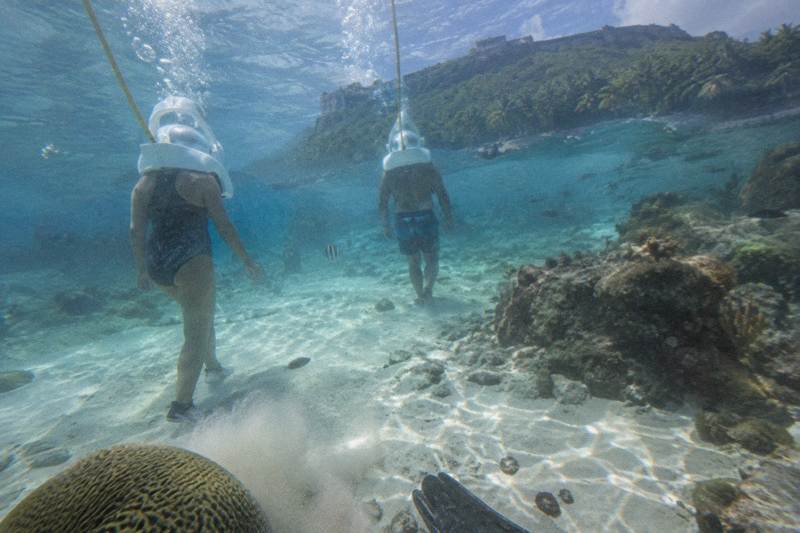
How Helmet Diving Works: The Helmet, The Air Supply And The Walk
Helmet diving in St Lucia works on a simple principle: a helmet held open-end-down traps air the way an inverted glass traps it underwater, while a hose from the surface feeds a constant flow of cooled, dried and filtered air. No swimming, no regulator, no certification.
Short answer
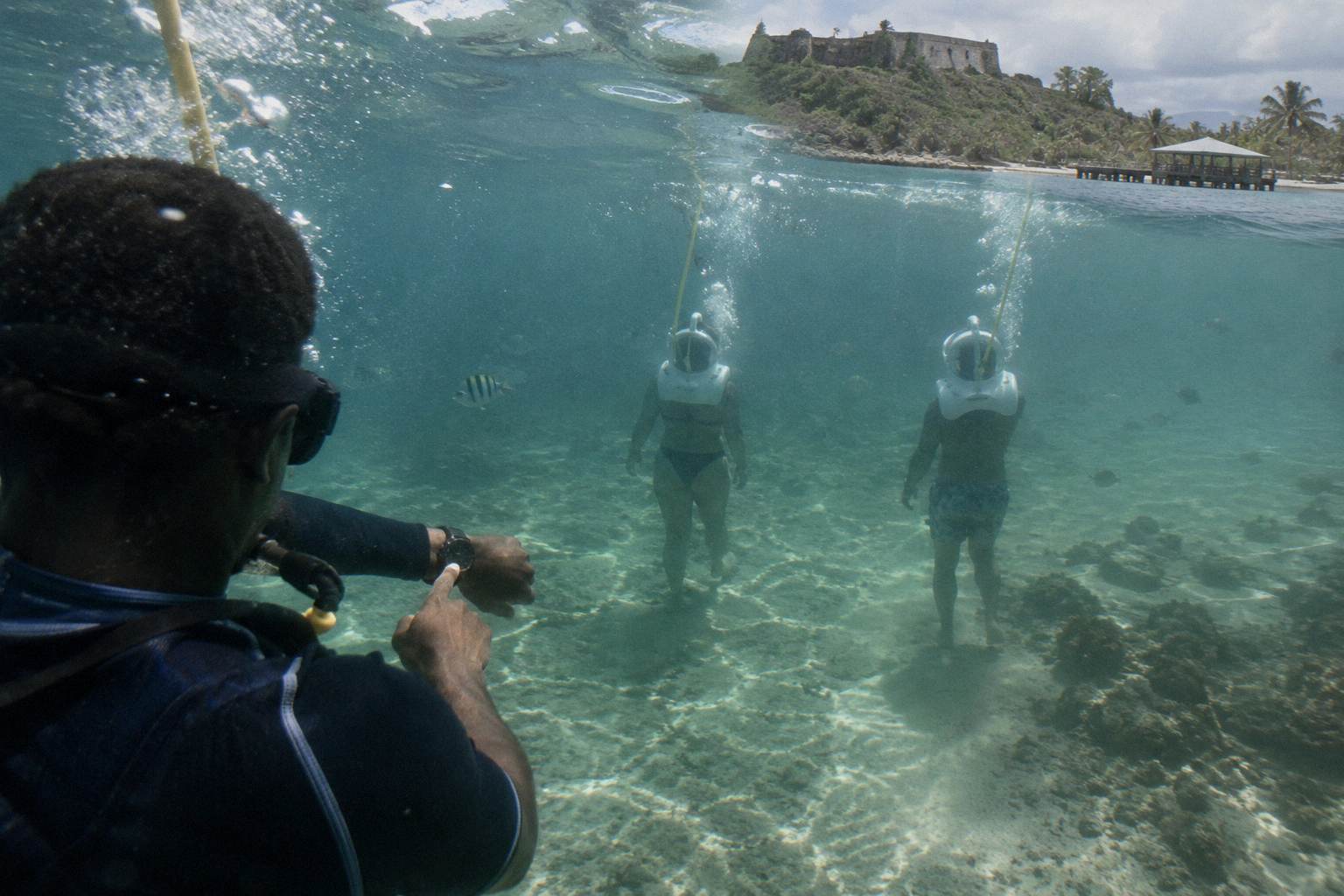
A helmet dive uses a sealed helmet resting on your shoulders, fed air by hose from a surface air center, so your head and face stay dry while you walk on the seabed. The St Lucia session runs 1 hour 30 minutes total, with about 10 minutes of briefing and about 25 minutes underwater, from US$118 per person.
Helmet diving sits in the family of beginner underwater experiences covered by the beginner underwater tours hub, and it is the one built for people who never learned to swim. The flagship session at Pigeon Island, "SeaTrek St. Lucia" run by Sealife Paradise, delivers the whole experience in 1 hour 30 minutes, about 10 minutes of it briefing and about 25 minutes of it walking the seabed under a helmet, from US$118 per person. This walkthrough explains the physics of the helmet, where the air comes from, what the session looks like from arrival to walk-back, and how the format compares with SNUBA and scuba.
| Fact | Detail |
|---|---|
| Product | SeaTrek St. Lucia, Seabed Helmet Walk, No Swimming |
| Operator | Sealife Paradise, departing Pigeon Island, Gros Islet |
| Total duration | 1 hour 30 minutes |
| Structure | About 10 minutes briefing, about 25 minutes underwater |
| Minimum age | 8 |
| Swimming needed | No |
| Price | From US$118 per person |
| Rating | 4.8 from 231 reviews |
| Cancellation | Free up to 24 hours before start |
| Pickup | Included from hotels in the north of the island only |
What Is Helmet Diving And How Does The Helmet Keep You Dry?
Helmet diving is a guided underwater walk in which a helmet resting on your shoulders holds a pocket of air around your head, so you breathe normally, keep your glasses on and stay dry from the neck up, with no swimming skill involved. The whole concept reduces to one piece of physics, and once that clicks, everything else about the experience follows from it. The manufacturer describes it plainly: the helmet works like a glass turned upside down.
That is the entire trick. Take a drinking glass, push it open-end-down into a basin of water, and the air trapped inside keeps the water out. The SeaTrek helmet does the same thing at walking depth: as long as the opening stays pointed down, air stays in and water stays out. You do not hold the helmet in place with your arms; it rests on your shoulders, sealed against the water column by nothing more exotic than the trapped air itself, which presses outward as the water presses in.
The manufacturer, SeaTrek by Sub Sea Systems, puts it in exactly those terms on the manufacturer's SeaTrek page: the helmet "works similar to an inverted glass", the air stays as long as the helmet is not turned over, and a constant flow of supply air keeps a fresh turnover inside. That last part matters. A sealed pocket of air would eventually go stale as you exhale into it, so the system never lets it stand still: fresh air pushes in from the surface, spent air spills out the bottom of the helmet, and the cycle runs continuously for the whole walk.
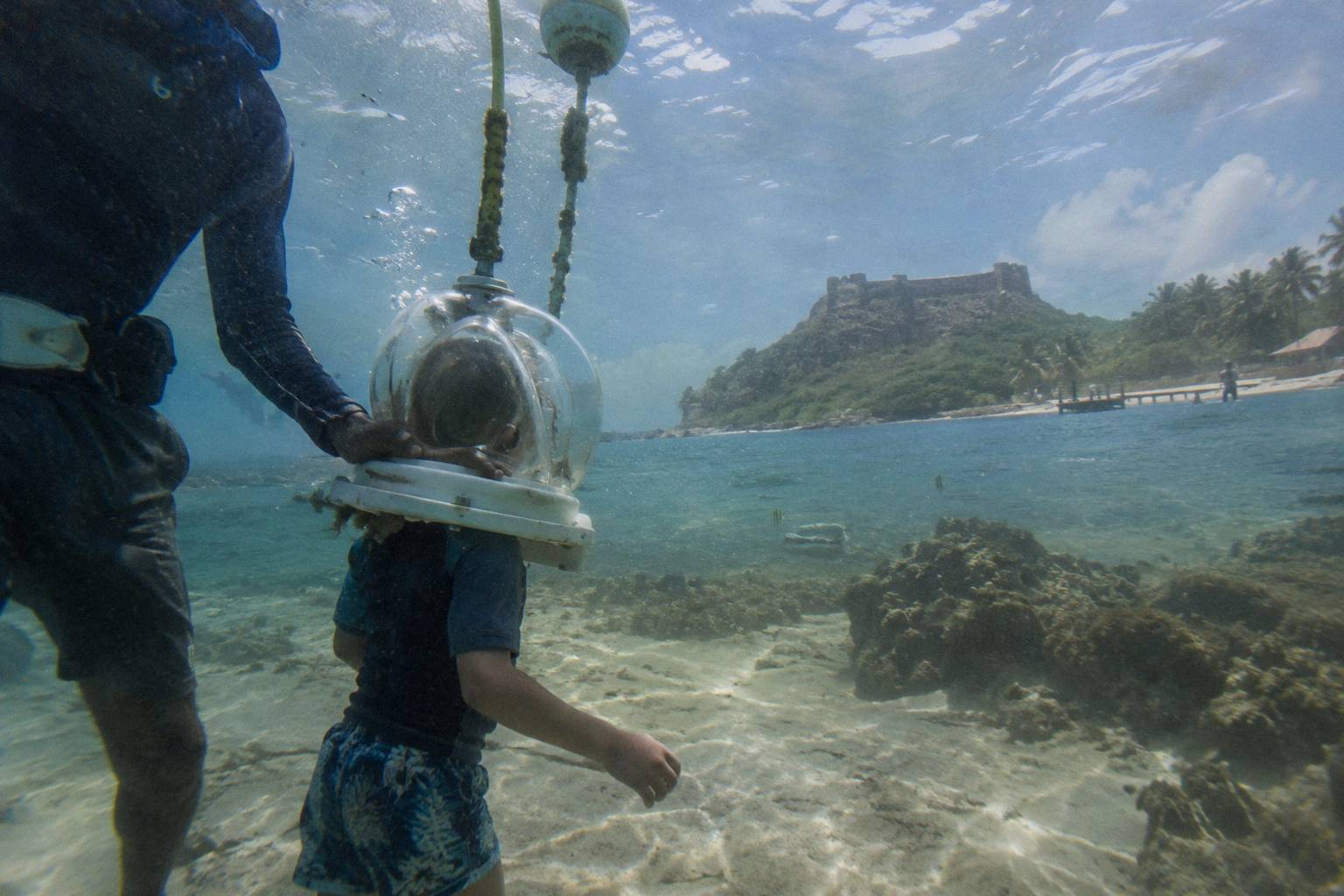
What that means for the person inside is simple. Head and face stay dry, in the manufacturer's description, and breathing is ordinary nose-and-mouth breathing, "just walk and breath" as the manufacturer's own phrasing goes. Prescription glasses can stay on, which is a small thing that decides the question for a lot of nearsighted travelers who cannot wear contacts in a mask. And because there is no regulator mouthpiece and no mask squeeze, the minimum age is 8 and no certification of any kind is needed.
The manufacturer also notes that tours are guided by trained and certified guides, and the operator, Sealife Paradise, uses the same framing on its own tours page: a "space-age helmet", natural breathing, no swimming needed, from ages 8 and up, and what the operator calls "near weightlessness" on the walk. None of that is a promise about a given day's water or what swims past, but it describes the mechanics accurately: you descend a ladder or ramp, the helmet goes on, and you walk.
The Air Supply Chain: From The Surface To Your Shoulders
Every breath you take underwater comes through a hose from an electrically powered air center on the surface, which supplies a constant flow of air that has been cooled, dried and filtered before it reaches the helmet. You carry nothing on your back, unlike scuba, and you share nothing with a raft, unlike SNUBA. The air arrives by hose, continuously, for as long as you are down.
That chain has three links, and each one does a defined job. On the surface sits the air center, electrically powered, which does the conditioning work: the air is cooled, dried and filtered before it travels anywhere. From the center runs the hose, the lifeline of the whole system, delivering the supply down to the walking depth. At the bottom end is the helmet itself, an open-bottomed dome in which the incoming air keeps up the constant turnover described above. The manufacturer's Q&A material also lists other supply configurations, including a portable pod, a backpack unit and an adapted chair, but the electrically powered surface center feeding a hose is the arrangement to picture for a beach-based session.
| Part of the system | Where it sits | What it does |
|---|---|---|
| Air center | On the surface, electrically powered | Cools, dries and filters the supply air |
| Supply hose | From the surface to the helmet | Carries the constant flow of air down |
| Helmet | Resting on your shoulders | Traps the air pocket open-end-down |
| Continuous flow | Inside the helmet | Pushes fresh air in, spills spent air out |
Two contrasts make the design easier to grasp. In scuba, the diver carries the air supply as a tank on the back, and the diver's own training manages it. In SNUBA, the operator describes it as "a cross between snorkeling and scuba diving": no tank, no training, with a regulator mouthpiece fed by hose from a floating raft on the surface. The helmet dive is the third configuration: surface-supplied like SNUBA, but with no mouthpiece at all, because the air pools around your head rather than being delivered through something you clench in your teeth.
The practical consequence of the constant flow is worth stating plainly. Because fresh air arrives continuously, the helmet does not fill with exhaled air the way a held breath or a poorly ventilated space would. Because the helmet is not turned over during a walk, the air pocket is not lost. And because the helmet rests on the shoulders rather than being clamped or bolted, the fit is about weight carried, not pressure sealed against the face, which is why glasses can stay on and why the manufacturer can advertise comfort for ages 8 up to 96 and beyond.
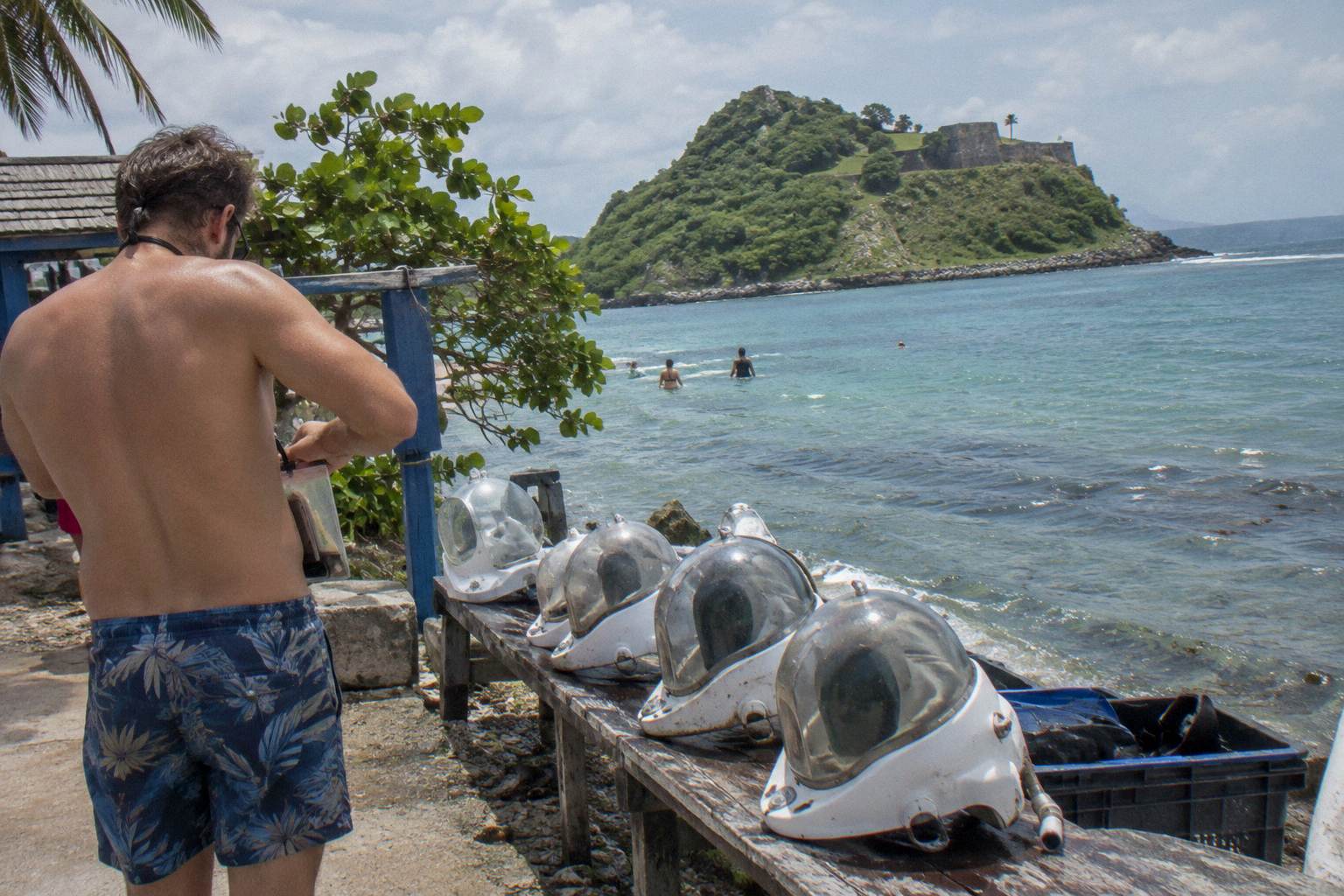
For the St Lucia session specifically, the operator's own page at Sealife Paradise tours page describes the SeaTrek product in the same terms: slip on the helmet, breathe naturally, no swimming required, certified guides, small groups, and free transfers within the north of the island. The session itself is booked as "SeaTrek St. Lucia", from US$118 per person, with private transportation included and gratuities excluded; all amounts are in US dollars, and the price varies by date and group, so the booking page shows the figure for your date. You can also read the full product detail on the SeaTrek underwater walk tour page and see whether the dates line up for your stay.
Each one trades something, air source against swimming requirement against time commitment, and the comparison section below lays those trades side by side.
The Helmet Itself: Materials, Weight And What It Feels Like
The helmet is built from polycarbonate and marine-grade components with a panoramic acrylic lens, and the manufacturer gives its underwater weight as about 15 lb, carried on the shoulders rather than the arms. Out of the water it is a heavy object; in the water, buoyancy offsets most of that, which is what the operator means by near weightlessness.
The materials are not incidental. Polycarbonate is the same family of plastic used in impact-resistant glazing, and marine-grade components are specified to survive salt water and sun without corroding between sessions. The panoramic acrylic lens is the part that shapes the experience: instead of staring through a small mask window, the walker has a wide, curved field of view, which changes how the seabed reads. You are looking out, not peering through.
On weight, only one figure exists and it belongs to the manufacturer: about 15 lb felt underwater, from a Q&A document that also lists a much heavier out-of-water figure. Print the underwater number as the manufacturer's, and treat nothing about it as a limit on who can take part, because no guest weight or height limit is published for the St Lucia session. If that question matters to you, ask the operator before booking. The same goes for what to bring: the what to wear and bring guide covers the practicalities in more depth than the booking page does.
The rest of the wearing experience follows from the physics in the first section. The helmet rests on the shoulders, open end down, with the hose trailing up to the surface. There is no strap, no bite, no equalizing maneuver as a scuba diver does, because the air space is at essentially the same pressure as the surrounding water at walking depth. The manufacturer's phrasing, "just walk and breath", is doing accurate work: the two actions are the whole skill set.
Can you take a camera down, or does the operator photograph the walk? Photos are not among the included items on the SeaTrek product, and the separate question of cameras underwater has its own write-up in the photos on a helmet dive guide. For now, book, walk, and treat any imagery as a bonus rather than a bundled item; the free cancellation up to 24 hours before start means the decision is reversible if the calendar shifts.
The Session Minute By Minute: What Happens In The 90 Minutes
The St Lucia helmet dive runs 1 hour 30 minutes from start to finish, and the tour breaks that into about 10 minutes of briefing and about 25 minutes underwater, with the remainder covering gearing up, the descent, the walk back and the return to the beach. The underwater portion is roughly a third of the clock, which is normal for surface-supplied experiences of this kind.
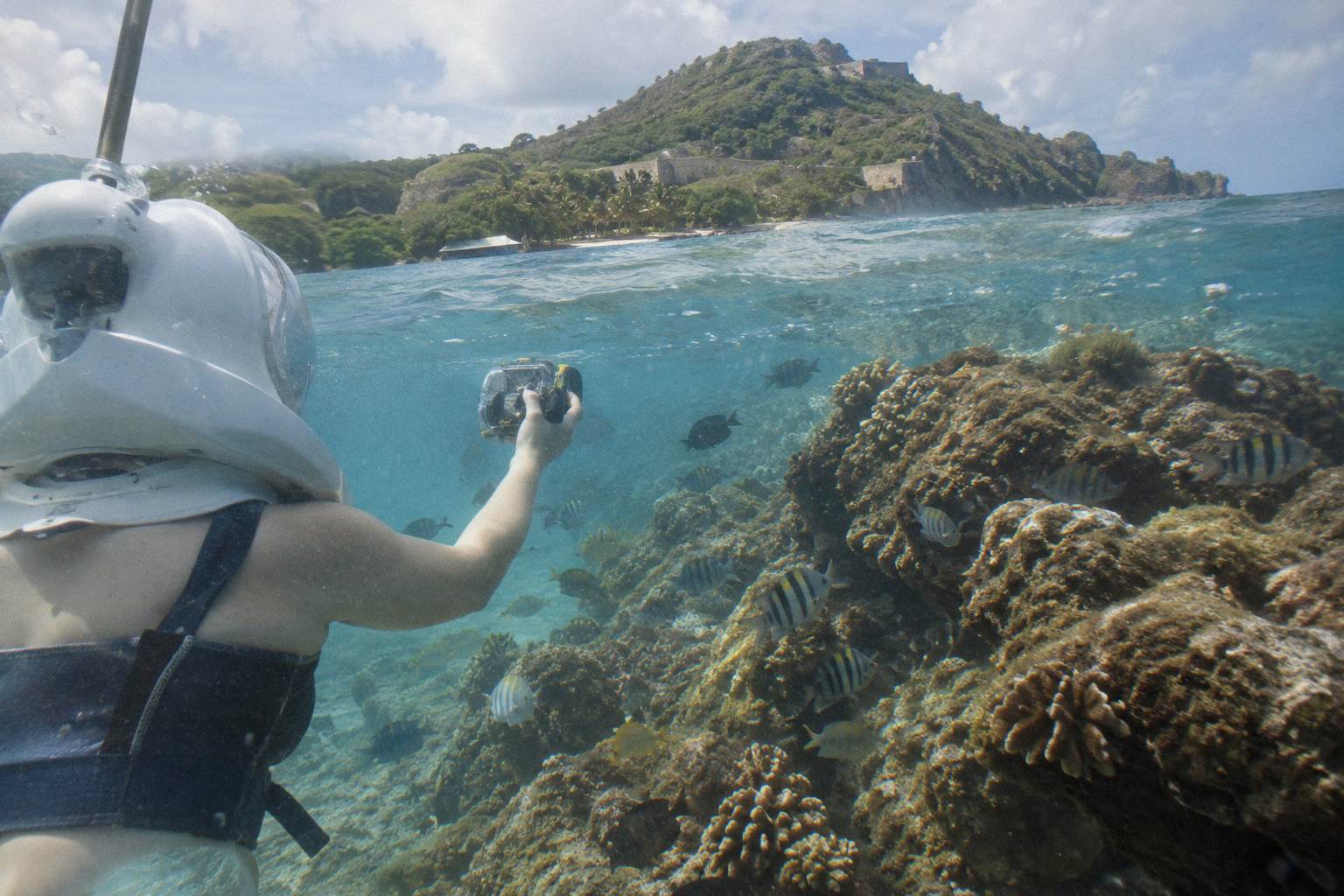
The briefing is where the physics gets handed to you in usable form. Guides are trained and certified, per the manufacturer, and the operator promises small groups with certified guides on its own page. In those roughly 10 minutes you learn the inverted-glass principle, how the descent works, hand signals, and the few things a walker must not do, chiefly anything that would tip the helmet's opening away from pointing down. Ear equalizing is not the scuba ritual of pinching and blowing; the air space is open to the water pressure at the bottom edge, and the walk stays shallow by design. Other pages covering the same trip are gathered on St Lucia Helmet Dive.
| Stage | Time from the tours on this site | What happens |
|---|---|---|
| Briefing | About 10 minutes | Safety run-through, hand signals, helmet principle |
| Gearing up and descent | Within the 90-minute total | Helmet fitted, ladder or ramp descent |
| Underwater walk | About 25 minutes | Seabed walk, guided, constant air flow |
| Return and wrap | Within the 90-minute total | Ascent, helmet off, back to the beach |
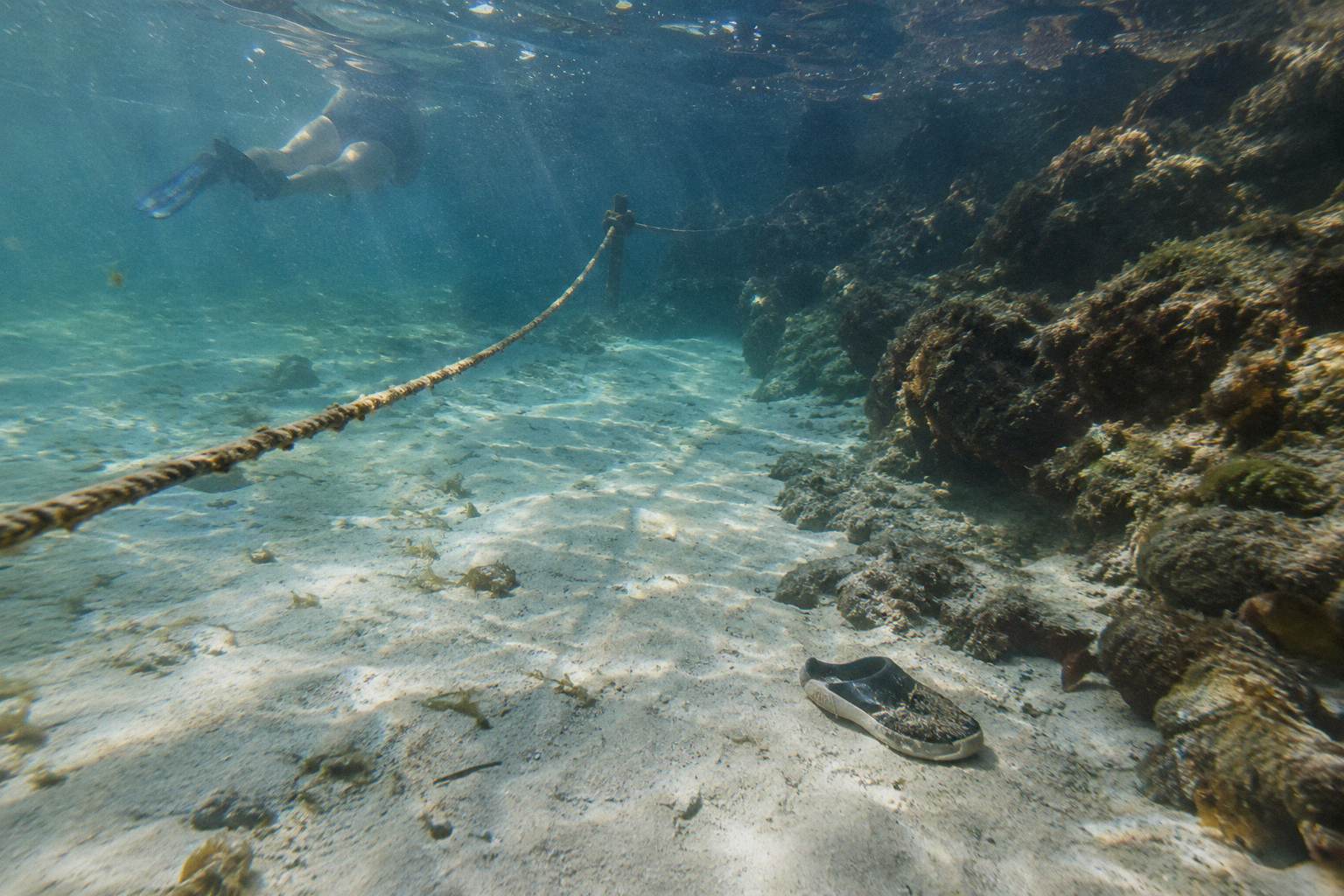
The 25 minutes underwater is the product. You walk, the guide walks with you, and the air hose pays out from the surface as you move. The session departs from Pigeon Island on St Lucia's north coast, a 44-acre National Landmark that the tourism authority describes as having calm, sheltered waters at its beach; what any given day delivers depends on weather, season and conditions, which no operator controls. Sea temperatures across the year sit between 26 and 29 C (79 to 84 F), and mornings tend toward the calmest water and clearest light, per the tourism authority's snorkeling guidance.
The walk ends the way it began, by ladder or ramp, and the helmet comes off at the surface. Gratuities are not included in the from-price, which is standard for guided experiences on the island, where the tourism authority's travel tips put tipping at about 10 to 12 percent of bills, not added automatically. None of the session's clock times are fixed in advance; the start time is chosen on the booking calendar when you reserve.
For readers connecting the dots between formats: the SNUBA session run by the same operator at the same departure point also runs 1 hour 30 minutes, from US$112 per person, rated 4.7 from 166 reviews, with a group maximum of 14 and equipment plus post-tour water included. It is the closest thing to a sibling product for the helmet walk, and the SNUBA at Pigeon Island comparison works through the differences in detail.
Who Helmet Diving Suits: Ages, Swimming And Confidence
The SeaTrek session accepts walkers from age 8, requires no swimming ability at all, and keeps glasses on and hair dry, in the manufacturer's description, which makes it the underwater option for non-swimmers, nervous first-timers and families with school-age children. The medical gate is the operator's own advisory, and the deciding factors are heart, spine and pregnancy rather than age or swim skill.
Start with swimming, because it is the question that brings most people here. The SeaTrek tour listing states it flatly: swimming not required. The manufacturer's marketing says the same thing with a smile, "Can't swim? No worries!", and the reason is structural. You are standing on the seabed with a helmet on, not propelling yourself through open water; nothing about the format asks you to float, kick or self-rescue. Snorkeling tours on the island, by contrast, list swimming ability as a requirement on every tour listing, and the snorkeling for non-swimmers guide addresses that gap from the other side.
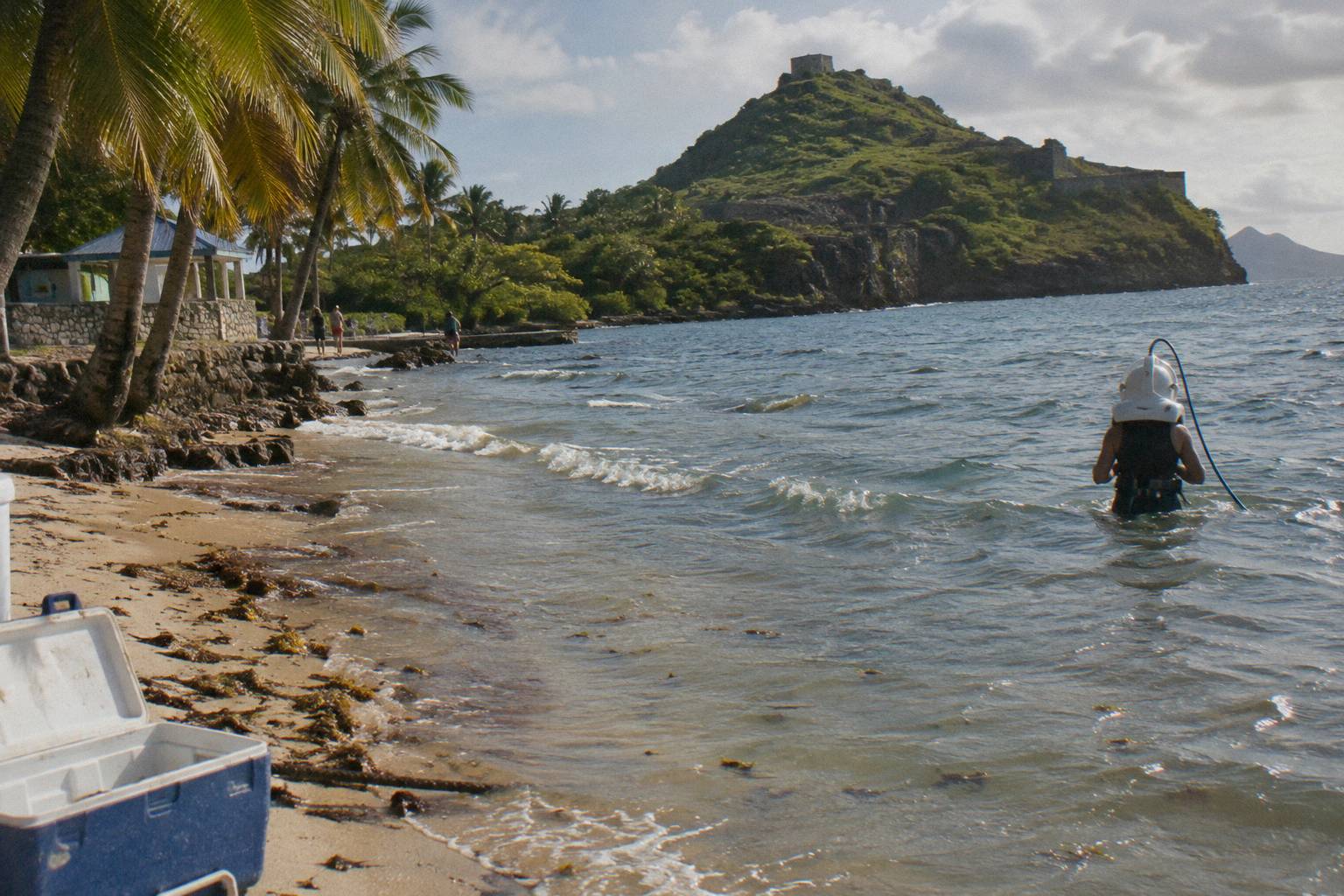
Ages run from 8 up, per both the tours on this site and the manufacturer, which stretches its phrasing to "ages 8-96+". Families should note the neighboring products' thresholds for comparison: the SNUBA session also starts at 8, the beach snorkel from the same operator starts at 6, and the beginner scuba day with Dive Fair Helen starts at 12 and runs 5 hours rather than 90 minutes. The age limits and kids guide covers the family decision in full.
The medical advisory is the operator's, printed on its booking material for both the SeaTrek and SNUBA products: not recommended for pregnant travelers, travelers with poor cardiovascular health, or travelers with spinal injuries. That is the operator's advisory, not a medical judgment from anyone else, and the right response to a question mark in your own history is to ask the operator or a doctor before booking. The wider safety picture, including what is and is not verified about the activity's risk profile, sits in the is helmet diving safe guide.
One group the format quietly serves well: travelers who want to say they stood on the seabed but do not want five hours of it. The beginner scuba option is a 5-hour day with training, lunch and one tank dive, from US$132 per person; the helmet walk is a tenth of the commitment for a first taste of breathing underwater. Neither is the better choice in the abstract; they answer different appetites.
Helmet Diving Versus SNUBA Versus Snorkeling: The Air Question
The three beginner formats differ mainly in where the air comes from and what the mouth does: the helmet holds surface-supplied air around your head, SNUBA feeds a regulator mouthpiece from a floating raft, and snorkeling uses a tube at the surface with swimming required. Format, not depth or daring, is the real choice, and the tour prices run from US$70 for a beach snorkel to US$118 for the helmet walk.
The table below compares the tour products on the dimensions that decide the purchase. All prices are per person, in US dollars, and vary by date and group; each rating is shown with its review count.
| Product | Air source | Mouthpiece | Swimming needed | Minimum age | Duration | From price |
|---|---|---|---|---|---|---|
| SeaTrek St. Lucia helmet walk | Hose from surface air center | None | No | 8 | 1 hour 30 minutes | US$118 |
| SNUBA Saint Lucia | Hose from floating raft | Regulator | No | 8 | 1 hour 30 minutes | US$112 |
| Snorkeling at Pigeon Island | Snorkel tube at surface | Snorkel | Yes | 6 | 1 hour 30 minutes | US$70 |
| St Lucia Beginner Scuba Diving Tour | Tank on the back | Regulator | Yes | 12 | 5 hours | US$132 |
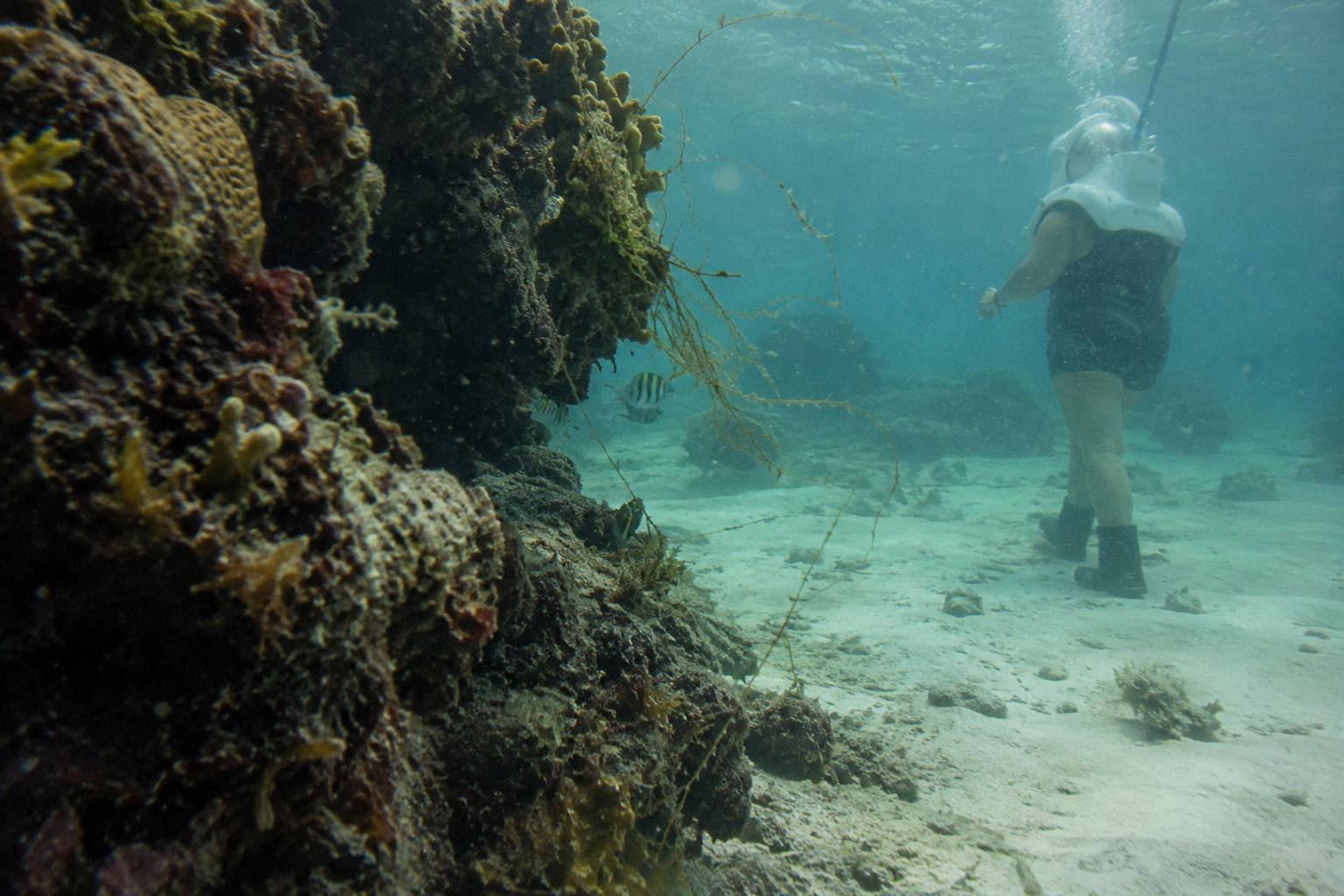
Ratings, with counts, for the four: the helmet walk carries 4.8 from 231 reviews, SNUBA 4.7 from 166, the beginner scuba day 4.7 from 57, and the beach snorkel 4.4 from 16. Those are each product's own figures and say nothing about ranking; what they do show is that all four have enough reviews for the score to mean something, and that satisfaction does not track price in a straight line.
Beyond air and price, the pickups differ in ways a planner should catch early. Both Sealife Paradise products at Pigeon Island include pickup from hotels in the north of the island only, with the exact meeting point on the booking confirmation. The Dive Fair Helen products run from Marigot Bay on the west coast with pickup from northern to western locations only, not from Soufriere, Vieux Fort, Micoud or Dennery, so southern-base travelers need to plan around that. The beach snorkel includes no pickup at all; you make your own way to Pigeon Island Beach. If the logistics of reaching the departure point matter to your itinerary, the getting to Pigeon Island guide maps the routes.
Cancellation is consistent across the tours here: free cancellation up to 24 hours before start on every product named above. That symmetry makes the decision low-risk, since a wrong format choice can be unwound a day out. The deeper format-by-format walkthrough, including where each sits for a nervous first-timer, is the SeaTrek versus SNUBA versus scuba versus snorkeling comparison.
What Trips People Up Before You Book
The avoidable errors are assuming south-coast hotels get pickup, expecting photos or entry fees inside the from-price, booking a same-day flight after any compressed-air activity without checking the rule, and showing up expecting a specific water color or fish list that no operator controls. Each of these is fixed with one question or one calendar check before paying, and all of them cost nothing to ask.
Pickup geography first. The helmet walk's included transportation covers hotels in the north of the island only, full stop. A traveler based in Soufriere or Vieux Fort needs their own plan to reach Pigeon Island, and Hewanorra airport to the Gros Islet area is about 1 hour 30 minutes by road, per the tourism authority's own distances. Do not assume the operator's transfer reaches the whole island; ask about your specific hotel when booking. Cruise passengers should check with the operator directly, since the session's own material does not cover cruise-terminal pickup.
Money second. The from-price of US$118 covers the walk and private transportation; gratuities are excluded, and photos are not among the included items. The Pigeon Island National Landmark charges its own entry, US$10 for non-resident adults and US$3 for children 5 to 12 in the National Trust's figures, which can change and are entirely separate from any tour. Lunch is not part of this product, though it is on other tours here. Reading the included and excluded lists on the booking page before paying prevents every one of these surprises.
Medical and travel timing third. The operator's advisory bars the session for pregnant travelers, those with poor cardiovascular health and those with spinal injuries; anything unclear in your own history goes to the operator or a doctor. On flying after compressed-air exposure, Divers Alert Network guidance for scuba sets a 12-hour preflight surface interval after a single no-decompression dive and 18 hours after multiple dives or multiple days of diving, but that is scuba guidance, and no official interval is published for helmet walking or SNUBA, so ask the operator if a flight day follows your session. The safety basics around any St Lucia water activity come from the tourism authority: many beaches have no lifeguards, never snorkel alone, mind boat traffic, use reef-safe sunscreen and never touch coral or marine life, guidance echoed on the Saint Lucia tourism beach safety page.
Expectation last. No straightforward walkthrough can promise what the water shows on a given morning. Sea state, weather and season decide, the west coast generally runs calmer, and mornings tend toward the calmest and clearest conditions. Book the format that fits your swimming, your ages and your clock, hold it loosely against the 24-hour free cancellation, and let the day deliver what it delivers.
Between the helmet walk, its SNUBA sibling at the same beach and the beginner scuba day down the coast, the choice above spans the realistic field, and every one of them can be cancelled free up to 24 hours before it starts.
Common Questions About The Underwater Walk
How Does Helmet Diving Work?
A helmet resting on your shoulders traps air the way an inverted glass traps it underwater, and a hose from an electrically powered surface air center feeds a constant flow of cooled, dried and filtered air into it. Your head and face stay dry, you breathe normally, and you walk the seabed with a guide. No swimming skill or certification is involved.
Do You Get Wet On A Helmet Dive?
From the neck up, no: the manufacturer states the head and face stay dry, and even hair stays dry, which is covered in the separate guide on that question. From the neck down, yes, you are standing and walking in the sea for about 25 minutes, so you get wet to the shoulders.
Can Non-Swimmers Do Helmet Diving?
Yes. The St Lucia SeaTrek session's description states swimming is not required, and the manufacturer says the same. You stand and walk on the seabed rather than swimming, and a trained and certified guide accompanies the walk. Non-swimmers who want other formats should read the snorkeling for non-swimmers guide, since every snorkel tour compared requires swimming ability.
How Long Does A Helmet Dive Last?
The St Lucia session runs 1 hour 30 minutes in total, of which about 10 minutes are briefing and about 25 minutes are spent underwater on the walk. The rest covers gearing up, the descent, the return and handing back the helmet. Start times are chosen on the booking calendar.
How Heavy Is The Helmet?
The manufacturer gives about 15 lb felt underwater, carried on the shoulders, with buoyancy offsetting most of the out-of-water weight. No guest weight or height limit is published for the St Lucia session, so if body size or shoulder load is a concern, ask the operator before booking.
Can Children Do A Helmet Dive In St Lucia?
From age 8, per both the tours on this site and the manufacturer, which stretches its phrasing to ages 8 to 96 and beyond. The SNUBA session from the same operator also starts at 8, while the beach snorkel starts at 6 and beginner scuba at 12. The age limits and kids guide works through the family decision.