Helmet Diving For Non-Swimmers: What To Expect Underwater
The helmet walk is the one underwater activity in St Lucia built for people who cannot swim at all. Here is what the manufacturer and operator actually say, what the session involves minute by minute, and where the swimming-ability lines sit across the other water tours.
Short answer
Yes. The SeaTrek St. Lucia helmet walk from Sealife Paradise runs from US$118 per person, lasts 1 hour 30 minutes with about 25 minutes underwater, requires no swimming skill and takes children from age 8. The manufacturer's own line is that comfortable walking is the only physical skill asked of you.
If the swimming pool has always been the thing that kept you out of the sea, the seabed walk is the product built for you. It sits in the beginner underwater tours for St Lucia family alongside SNUBA and the beginner try-dive, and it is the one where the operator's own pitch leads with the words "No Swimming needed". The short version of everything below: a sealed helmet on your shoulders, a hose of air from the surface, a walk on the sand, and no stroke of swimming anywhere in it.
| Fact | Detail |
|---|---|
| Product | SeaTrek St. Lucia, Seabed Helmet Walk, No Swimming |
| Operator | Sealife Paradise |
| Where | Pigeon Island, Gros Islet |
| Price | From US$118 per person |
| Duration | 1 hour 30 minutes, with about 10 minutes of briefing and about 25 minutes underwater |
| Swimming | Not required |
| Minimum age | 8 |
| Cancellation | Free up to 24 hours before start |
| Pickup | Included from hotels in the north of the island only |
Amounts are in US dollars, and prices vary by date and group; the booking page shows the price for the day you choose.
Can You Do A Helmet Dive If You Cannot Swim?
Yes, without qualification, and it is the only underwater format on this island's beginner lineup that says so outright. The manufacturer's page for the helmet system puts it in its own words: "Can't swim? No worries! Comfortable walking?" That is the whole physical requirement as stated, walking. The tour line for the SeaTrek St. Lucia walk carries a plain swimming-not-required flag, and the operator's own description leads with no swimming needed, from age 8, just walk and breathe.
The distinction matters because the water lineup in St Lucia is not uniform on this point. Every snorkeling product compared carries a swimming-ability flag on its own line: the Pigeon Island beach snorkel, the boat snorkel with lunch, the private boat to Soufriere and the full-day excursion all state swimming ability is needed. SNUBA, the surface-raft hose format, carries no swimming flag on its line. The helmet walk is the format that goes a step further and states the opposite: swimming is not part of it at all.
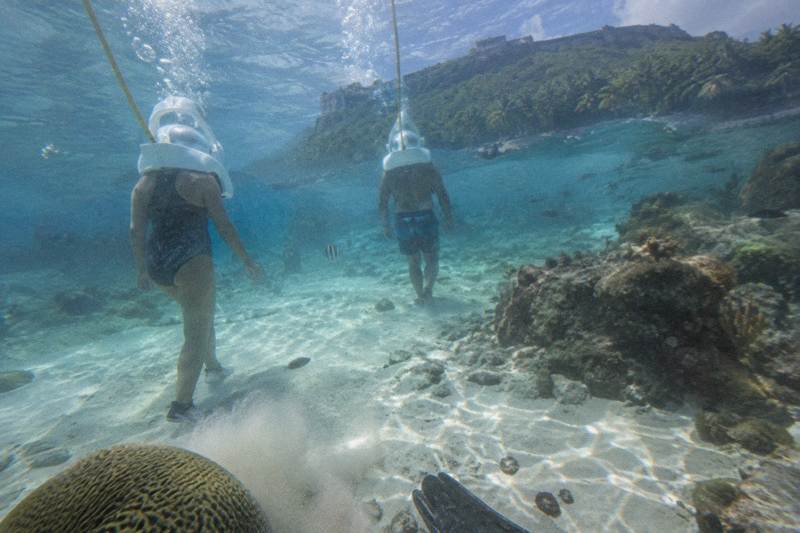
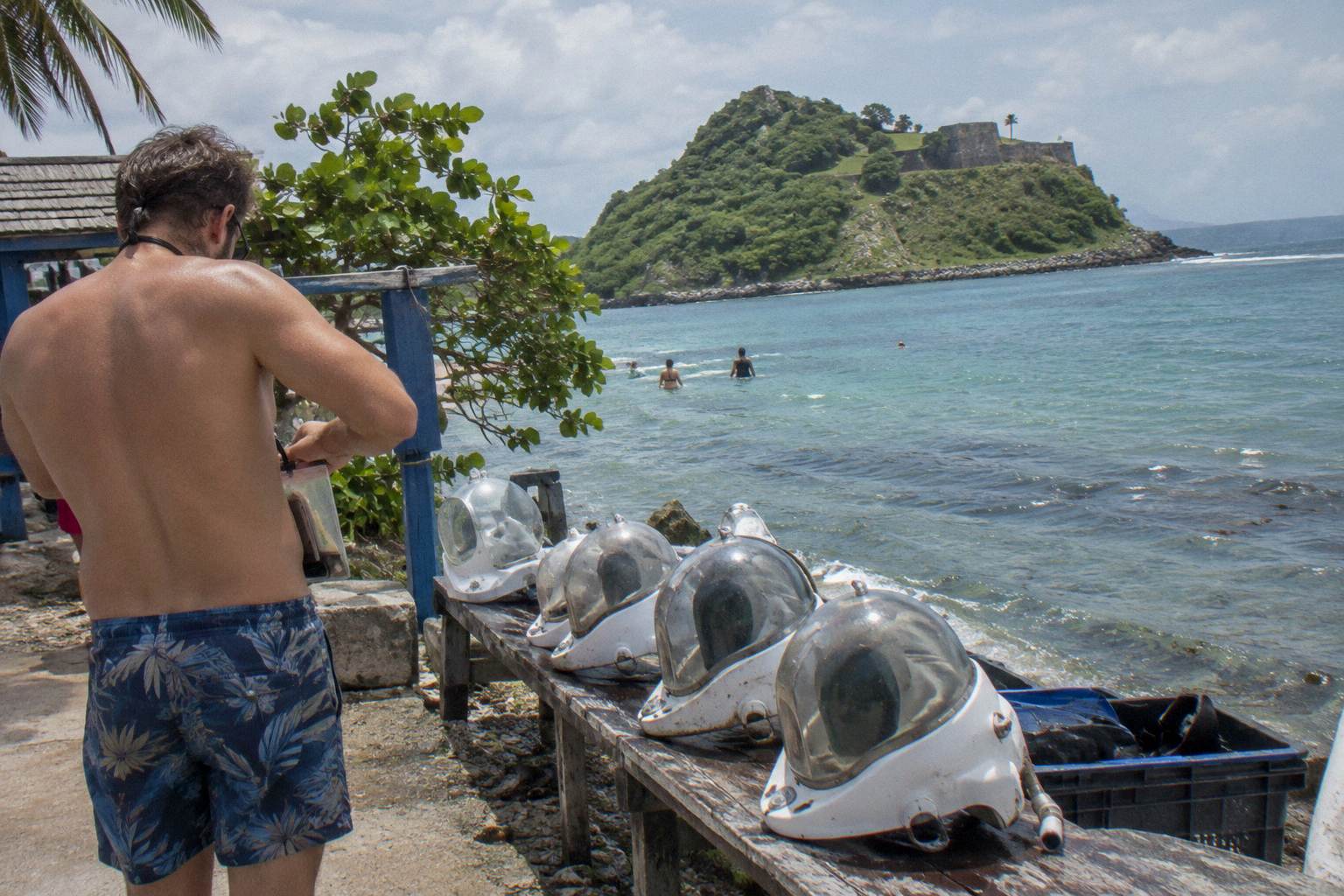
The reason is mechanical rather than motivational. In the helmet you are not floating, kicking or keeping your own head above water. You are standing and walking on the seabed with the helmet resting on your shoulders, breathing air delivered down a hose from the surface. The swimming problem, staying up and breathing, is solved by the equipment rather than by you. The manufacturer's own explanation is that the helmet "works similar to an inverted glass": air stays inside as long as the helmet is not turned over, and a constant flow of cooled, dried and filtered air keeps the inside fresh, per the manufacturer's SeaTrek page.
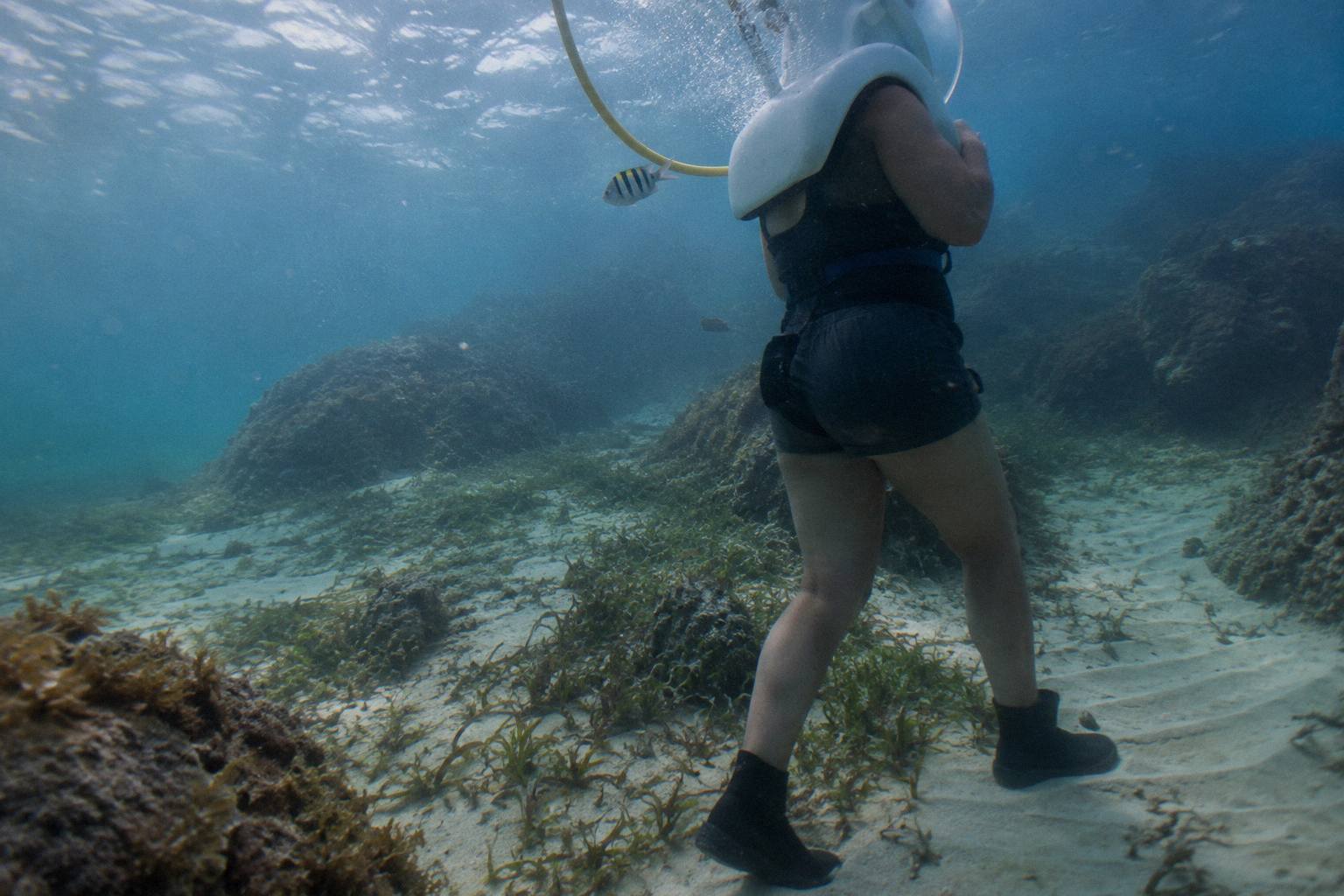
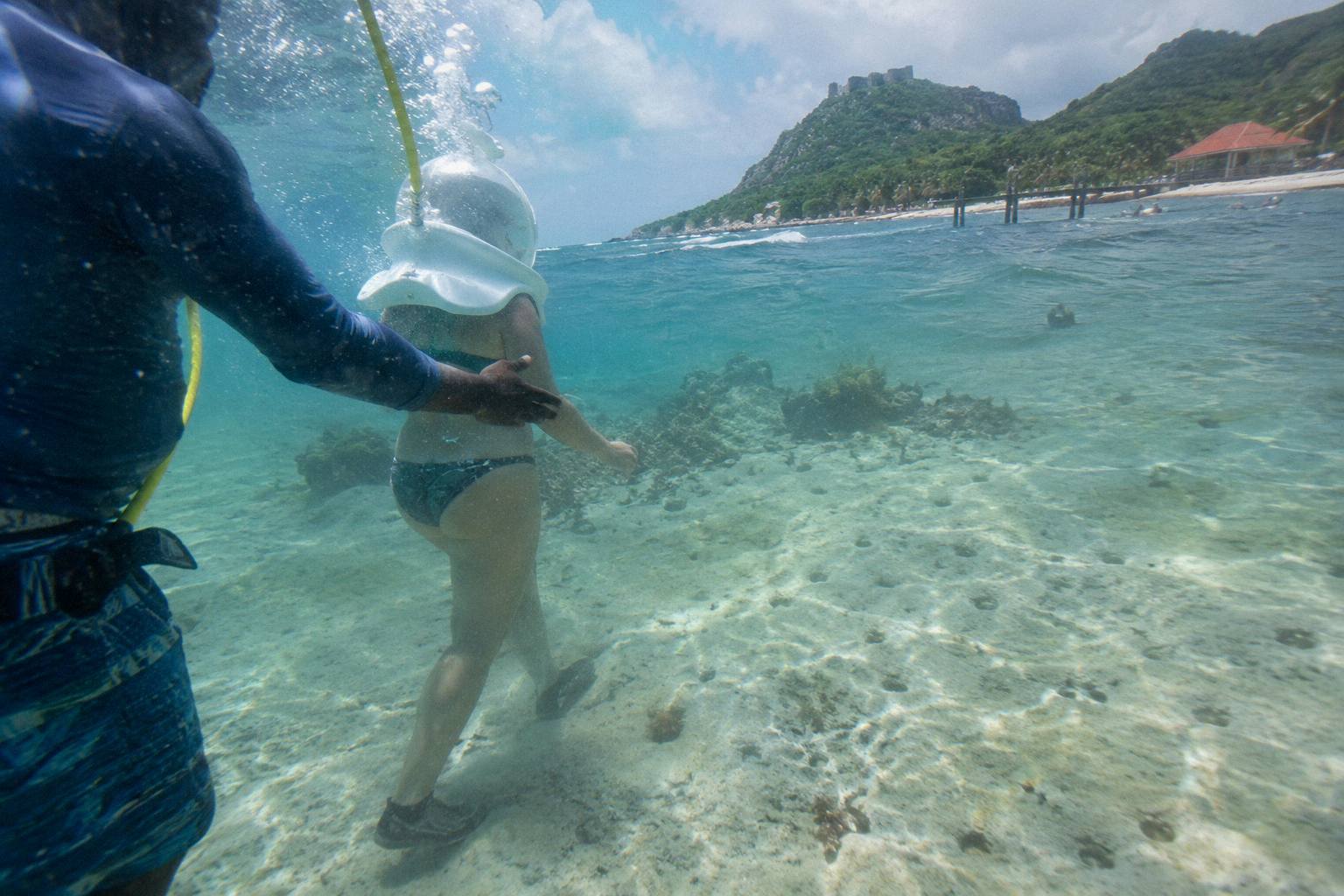
For a nervous non-swimmer, the fair framing is this: the skills asked of you are walking on sand, standing still, and following a guide. Guides on these tours are trained and certified, in the manufacturer's wording, and they are in the water with the group. Nothing about the format requires you to let go of anything, put your face in the water, or float. Whether the experience feels comfortable is yours to judge; what the equipment does is documented, and it does not depend on your swimming.
How The Helmet Keeps Your Head Dry And Your Air Coming
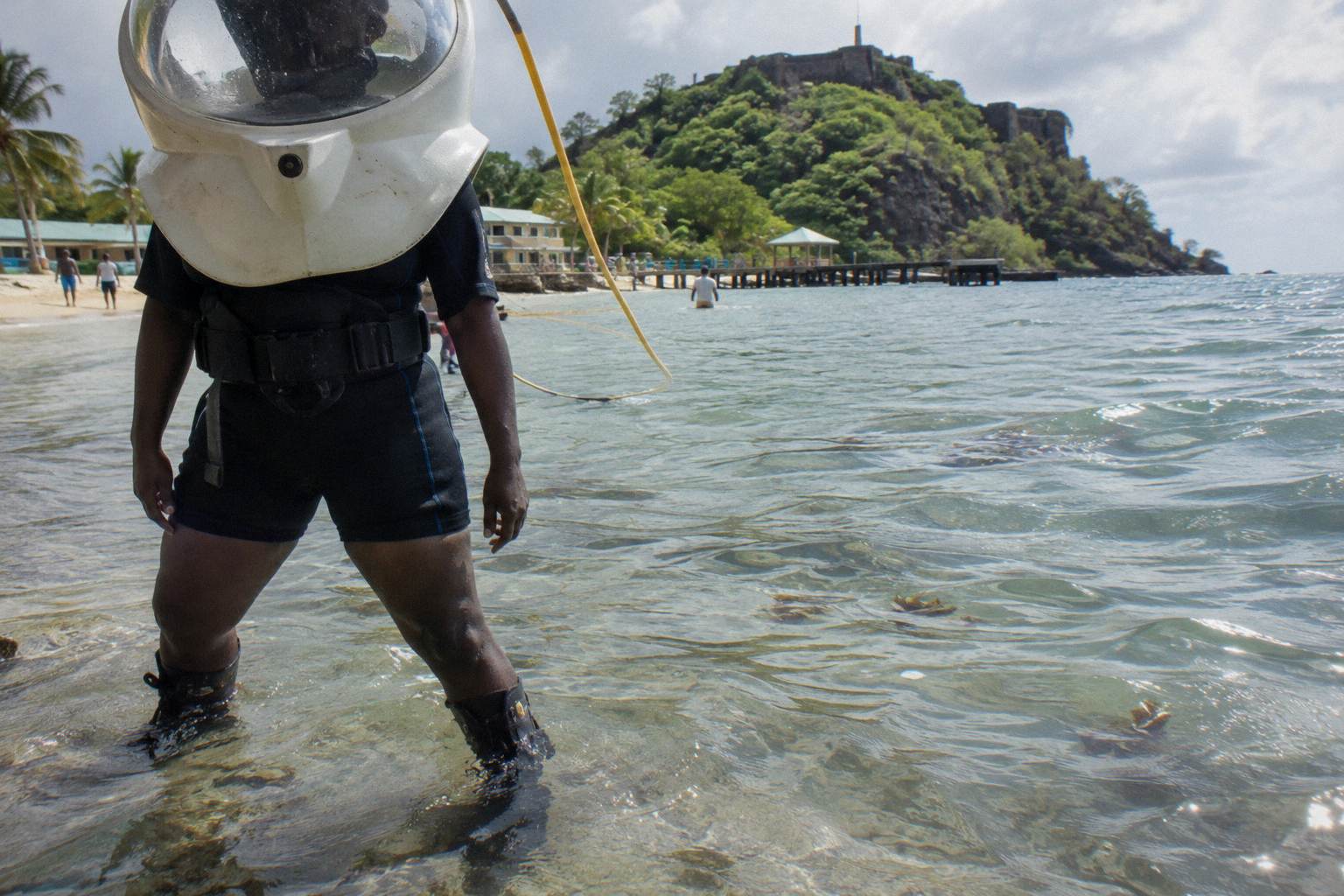
The helmet is an air-filled dome resting on your shoulders, fed by a hose from a surface air center, and the manufacturer describes it as working like an inverted glass. Air stays in it the way water stays trapped in a glass pushed upside down into a sink. Your head and face stay dry inside it, in the manufacturer's description, and prescription glasses can stay on, which no mask or snorkel format offers.
The details come from the manufacturer's technical description. Air is supplied from the surface through a hose connected to an electrically powered air center that pushes a constant flow of cooled, dried and filtered air into the helmet. That constant turnover is what keeps the air inside fresh rather than stale. The helmet itself is built from polycarbonate and marine-grade components with a panoramic acrylic lens, so the view out is wide and the shell is built for repeated marine use rather than being a novelty item. The manufacturer gives the helmet's underwater feel as about 15 lb, its own figure for how the helmet behaves in water, though that is a description of the equipment and not a limit placed on a guest.
Two practical consequences follow for a non-swimmer. First, glasses: the manufacturer's page says "Glasses on? No problem!", because your face is in air, not pressed against a mask skirt. Second, hair and face: the operator's and manufacturer's description is that head and face stay dry, and the manufacturer's shorthand for the whole experience is "just walk and breath". These are the manufacturer's and operator's own phrases, printed as their description of how the system is designed to behave.
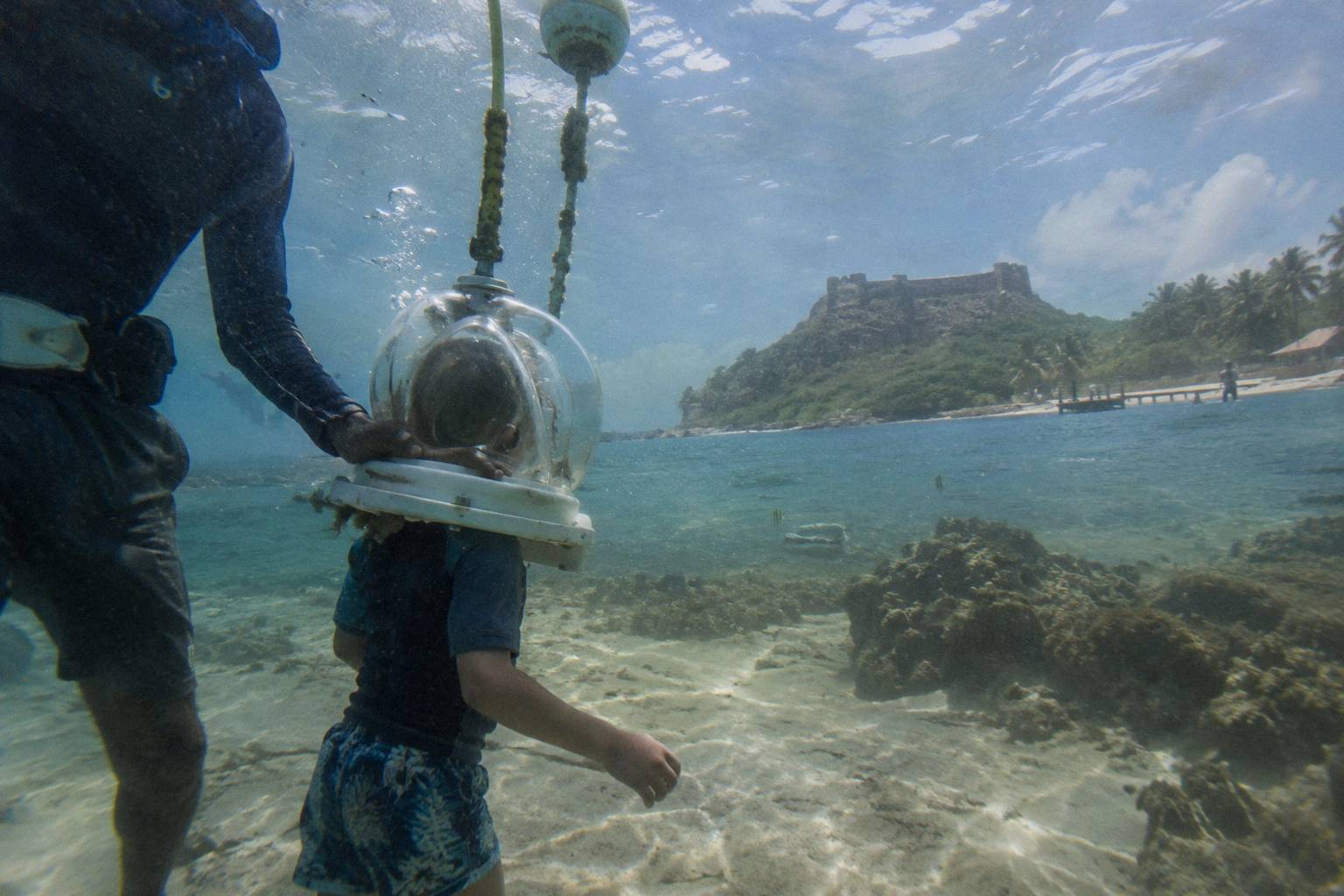
What the system does not do is eliminate the water around you. You walk out into the sea, you descend a ladder or ramp with the helmet on under guide supervision, and you spend your underwater time walking on the bottom with water above and around you but not inside the helmet. No source promises calm water or particular conditions on a given day; sea temperatures in St Lucia sit between 26 and 29 C all year, and the Tourism Authority notes morning tends to be the calmest and clearest period, per the Saint Lucia tourism snorkeling beaches page.
If the inverted-glass physics is what reassures you, the fuller breakdown of the air hose, the surface unit and what happens if the flow changes is in how helmet diving works, the air hose and helmet explained.
What Happens In The Ninety Minutes, Step By Step
The SeaTrek St. Lucia session runs 1 hour 30 minutes in total, and that breaks down into roughly three phases: about 10 minutes of briefing on land, about 25 minutes walking underwater, and the remainder for gearing up, getting in and out, and the walk back. Underwater time is a walk, not a swim, and guides are in the water with the group throughout.
The briefing comes first, about 10 minutes of it. This is where the guides, trained and certified in the manufacturer's description, cover how the helmet behaves, how to walk with it, hand signals and what to do with your glasses, which stay on. The helmet is lowered onto your shoulders at the surface, the air hose is connected, and you descend into the water with staff supervising. Once on the bottom, the format is literal walking: the operator's own site describes slipping on the helmet, breathing naturally and stepping into the world off the beach with no swimming required.
| Session phase | Rough duration | What happens |
|---|---|---|
| Briefing | About 10 minutes | Safety and walking instructions from the guides |
| Gearing up and entry | Within the remaining time | Helmet fitted on the shoulders, hose connected, supervised entry |
| Underwater walk | About 25 minutes | Walking the seabed with guides in the water |
| Exit and wrap | Within the remaining time | Supervised exit, gear off, return |
The setting is Pigeon Island, Gros Islet, on the island's north end. The Tourism Authority describes Pigeon Island Beach as having calm, sheltered waters, its wording on the beach page, and the surrounding rocky coastline attracts a variety of fish and marine life. No particular sighting or visibility is promised on any day; what is documented is the venue and the format. The landmark itself is worth knowing about: 44 acres, a National Park since 1979 and a National Landmark since 1992, joined to the mainland by a causeway built in the early 1970s, with Fort Rodney, Signal Peak and a museum on the grounds, per the Saint Lucia tourism Pigeon Island page. The National Trust opens the landmark daily from 9:30 am to 5:00 pm with last entry at 4:15 pm, closed December 25, and its non-resident entry fees are US$10 for adults 13 and over, US$3 for children 5 to 12, under 5 free; those are the Trust's own figures, they can change, and whether a tour visit involves them is a question for the operator.
The full walkthrough of depth and duration questions, including what the session does and does not involve, continues in how deep and how long a helmet dive lasts.
How It Compares With SNUBA And Snorkeling For Non-Swimmers
Snorkeling is off the table for a non-swimmer here on the strength of the product lines themselves: all four snorkeling tours state swimming ability is needed. SNUBA carries no swimming flag on its line, and the helmet walk states swimming is not required. If the question is which underwater format a non-swimmer can book today, the helmet walk is the one whose own line answers it directly.
The contrast is best seen side by side. The helmet walk from Sealife Paradise, SNUBA from the same operator at the same Pigeon Island departure point, and the beach snorkel next door, three formats at one venue with three different relationships to swimming.
| Product | Format | Swimming requirement | Minimum age | From price |
|---|---|---|---|---|
| SeaTrek St. Lucia, Seabed Helmet Walk | Seabed walk with surface-fed helmet | Not required | 8 | US$118 per person |
| SNUBA Saint Lucia | Regulator on a hose from a floating raft | No flag on its line | 8 | US$112 per person |
| Snorkeling at Pigeon Island | Beach snorkel | Swimming ability needed | 6 | US$70 per person |
SNUBA sits in the middle. The operator describes it as a cross between snorkeling and scuba diving: no tank on your back, no certification, breathing through a regulator fed by hose from a raft floating on the surface above you. That is a genuine step toward the underwater world for someone hesitant about full scuba, but it is still you in the water, moving and breathing through a mouthpiece, which is a different proposition from standing in a helmet. Whether a non-swimmer is comfortable in that format is a question to put to the operator before booking; the SNUBA listing simply carries no swimming flag, and nothing further is published beyond that.
Snorkeling, by contrast, is defined by floating on the surface with your face in the water through a snorkel, and every snorkeling tour on the island states the requirement plainly. The boat snorkel with lunch from Dive Fair Helen, from US$83 per person, 5 hours, minimum age 4, carries the swimming flag; note its price excludes a 10% per person government VAT payable at check-in, and its pickup covers northern to western island locations only, not the south. The private boat and the full-day excursion carry the same flag. The beach snorkel at Pigeon Island, from US$70, needs swimming ability and a minimum age of 6, and it includes bottled water and snorkel equipment with no pickup. For a swimmer in your group who wants something alongside your helmet walk, that beach session runs from the same stretch of sand.
The wider field, scuba and all four snorkel formats compared format by format, is laid out in SeaTrek vs SNUBA vs scuba vs snorkeling, which fits you.
Ages, Pickup, Cancellation And What Is Included
The helmet walk takes ages 8 and up, includes private transportation from hotels in the north of the island only, excludes gratuities, and carries free cancellation up to 24 hours before the start. Photos are not among the listed included items. The exact meeting point arrives on the booking confirmation, and the start time is chosen on the booking calendar rather than printed anywhere here.
The age line matches the manufacturer's own framing, which describes the format as running from ages 8 to 96 plus, kids 8 and up, guided by trained and certified guides on every tour. For a family where the adults cannot swim and the children can, or the reverse, 8 is the shared floor across both the helmet walk and SNUBA, while the beach snorkel drops to 6 and the boat snorkel to 4, both of which require swimming ability anyway. Families weighing the decision have a fuller breakdown in age limits and kids on a SeaTrek dive.
| Item | The helmet walk's line |
|---|---|
| Minimum age | 8 |
| Included | Private transportation |
| Excluded | Gratuities |
| Photos | Not among the included items |
| Pickup area | Hotels in the north of the island only |
| Meeting point | Given on the booking confirmation |
| Cancellation | Free up to 24 hours before start |
Pickup geography deserves a hard look before you book. Sealife Paradise covers hotels in the north of the island only, Gros Islet, Rodney Bay and surrounds, and the exact meeting point comes with the booking confirmation. If you are staying in the south near Soufriere or Vieux Fort, that is a conversation with the operator rather than an assumption. Cruise passengers should read the getting-there picture carefully, since cruise-terminal pickup for the helmet walk is not documented anywhere sourced; the fuller logistics picture is in getting to Pigeon Island from Rodney Bay, Castries and the cruise ports. For orientation, the tourism body puts Hewanorra to Gros Islet at about 1 hour 30 minutes and Hewanorra to Pigeon Island at about 1 hour 40 minutes.
The cancellation window is the practical safety net for a nervous first-timer: free cancellation up to 24 hours before the start applies on the helmet walk, SNUBA and every other tour compared. Check the live price and pick your date on the booking calendar before the window matters.
If Swimming Is Only Part Of The Worry
For many non-swimmers the deeper question is comfort, not skill: what it feels like to be underwater at all, with water overhead, wearing a heavy-looking helmet. The documented answers are limited but real: head and face stay dry, the manufacturer gives about 15 lb as the underwater feel of the helmet itself, glasses stay on, and certified guides are in the water with you. Anything beyond that is personal, and no page can promise comfort.
Start with the weight question, because it is the most common. The helmet is a substantial object out of the water, and the manufacturer's own Q&A material gives its underwater feel as about 15 lb, its figure for the equipment, not a limit imposed on a guest. The water does most of the supporting; what you manage is the walk. The companion piece on the equipment numbers is how heavy a SeaTrek helmet is, and the hair question, a surprisingly frequent one for non-swimmers who have never worn a mask or hood, is answered from the same manufacturer material in whether your hair gets wet on a helmet dive.
Then the medical layer, which applies to swimmers and non-swimmers equally. The operator's booking page carries an advisory for both the helmet walk and SNUBA: not recommended for pregnant travelers, travelers with poor cardiovascular health or travelers with spinal injuries. That is the operator's own caution, printed as theirs, and the right response to it is to ask the operator or a doctor about your own situation before booking. The medical questions, including pregnancy, are handled at full length in medical conditions and pregnancy on a helmet dive.
Finally, fear itself. No operator page and no manufacturer description can promise you will feel calm, and nothing here tries to. What can be said is what the format removes: floating, kicking, breathing through your mouth in open water, and the mask-on-face sensation, since the helmet leaves your face in air. The safety questions that can be answered, and the ones that cannot, are laid out in whether helmet diving is safe, the risks and limits. Whether you will enjoy the seabed is discovered on the seabed, with a guide beside you and a hose of filtered air keeping the glass full.
What If You Want To Try Swimming-Based Formats Later
The natural progression for a non-swimmer who enjoys the helmet walk is not scuba but the water itself: snorkeling from a beach, then a boat, with swimming lessons or a swim vest conversation happening off these pages. What the tours on this site show is a clean ladder of commitments, from the US$70 beach snorkel through the US$83 boat tour with lunch to the US$132 beginner scuba try-dive, each with its own age floor and swimming requirement.
The beach snorkel at Pigeon Island is the shallowest rung: 1 hour 30 minutes, minimum age 6, from US$70 per person, equipment and bottled water included, no pickup, swimming ability needed. It shares the venue with the helmet walk, so a mixed group can split formats at one location on one morning. The boat snorkel with lunch from Dive Fair Helen, from US$83 per person for 5 hours with pickup from northern to western locations, adds a boat, a meal and the 10% VAT payable at check-in; remember the southern exclusion, Soufriere, Vieux Fort, Micoud and Dennery are outside its pickup zone.
The beginner scuba try-dive from the same operator, from US$132 per person over 5 hours with a minimum age of 12, includes training before the dive, lunch, water and juices, tanks and weights, marine fees and pickup from northern to western locations. It is a real scuba experience with an instructor and training, which places it beyond the non-swimmer question entirely, but it shows where the ladder ends for someone who learns to swim and catches the bug. The full picture of that product is in the beginner scuba try-dive and what it involves.
For swimmers already in the family, the private boat format from Captain Cliff Adventure Tours, from US$200 per person for 4 to 6 hours, dock pickup at Castries, Marigot Bay or Rodney Bay, gear and beverages included, lunch from about US$15 per person and a fuel surcharge excluded, is the flexible option; it carries the swimming flag like every snorkel line. None of these are today's question, but knowing the ladder helps you see the helmet walk's place on it: the first rung, and the only one that does not ask you to swim.
What Trips People Up Before You Book
The four recurring mistakes are assuming every water tour in St Lucia suits non-swimmers, booking from a southern hotel and expecting pickup, treating the 90 minutes as 90 minutes underwater, and showing up without having read the operator's medical advisory. Each of these is avoidable in a few minutes of planning, and none of them is made right by the operator on the day.
The first mistake is the swimming assumption. The beach-snorkel line, the boat line, the private boat and the full-day excursion all state swimming ability is needed, and a non-swimmer booked onto one of those is booked onto the wrong product. Read the line before the card. The second is geography: the helmet walk's transportation covers hotels in the north only, and the scuba and boat-snorkel products from Marigot Bay cover northern to western locations, excluding Soufriere, Vieux Fort, Micoud and Dennery. Ask the operator from where you are staying before you rely on pickup.
The third is time expectations. The session is 1 hour 30 minutes in total, of which about 10 minutes is briefing and about 25 minutes is underwater; the balance is gear, entry and exit. Booking the afternoon flight around a mythical hour of seabed time is how cruise-day plans break. The fourth is the medical advisory: not recommended for pregnant travelers, travelers with poor cardiovascular health or spinal injuries, in the operator's own wording, and it applies to the helmet walk and SNUBA alike. Ask the operator or a doctor, once, before booking, rather than at the water's edge.
A fifth, quieter trap is the entry-fee question at Pigeon Island. The National Trust charges non-resident entry, US$10 adult and US$3 child, and whether a tour visit intersects with that is not published or confirmed at booking; ask the operator rather than assuming either way. And on money generally: US dollars are widely accepted, the Eastern Caribbean dollar is pegged at EC$2.70 to US$1, and change often comes in EC$, so carrying small notes for gratuities, which are excluded on the helmet walk's line, is the practical move.
For the wider mistakes list, including photos, glasses and what not to wear, see what to wear and bring to a helmet dive, and for the photography rules specifically, whether you can take photos on a helmet dive. This walkthrough, like every guide on St Lucia Helmet Dive, is built from the manufacturer's and operator's own published material and the tours on this site for each product.
Common Questions About Booking Without Swimming Skills
Can You Do A Helmet Dive If You Cannot Swim?
Yes. The SeaTrek St. Lucia line states swimming is not required, and the manufacturer's own page says "Can't swim? No worries! Comfortable walking?" The format is a walk on the seabed with a helmet on your shoulders and air supplied from the surface, so floating and swimming are not part of it. The minimum age is 8.
Do You Have To Put Your Face In The Water?
No. The manufacturer's description is that head and face stay dry inside the helmet, which works like an inverted glass with a constant flow of cooled, dried and filtered air from the surface. Prescription glasses can stay on, in the manufacturer's words, "Glasses on? No problem!"
How Long Are You Actually Underwater?
The session runs 1 hour 30 minutes in total, with about 10 minutes of briefing and about 25 minutes underwater. The remainder covers gearing up, supervised entry and exit, and the walk back. Start times are chosen on the booking calendar.
Is Pickup Included For The Helmet Walk?
Private transportation is included from hotels in the north of the island only, and the exact meeting point comes on the booking confirmation. If you are staying in the south of the island, ask the operator before booking.
What Is The Minimum Age, And Can Kids Who Swim Join?
The minimum age is 8 for both the helmet walk and SNUBA. The beach snorkel at Pigeon Island takes ages 6 and up, and the boat snorkel with lunch takes ages 4 and up, but both of those require swimming ability. The helmet walk is the format that needs no swimming at all.
Can You Cancel If You Change Your Mind?
Yes, the helmet walk carries free cancellation up to 24 hours before the start, as does every other tour compared here. That window is the practical backstop for a nervous first-timer deciding whether to go through with it.