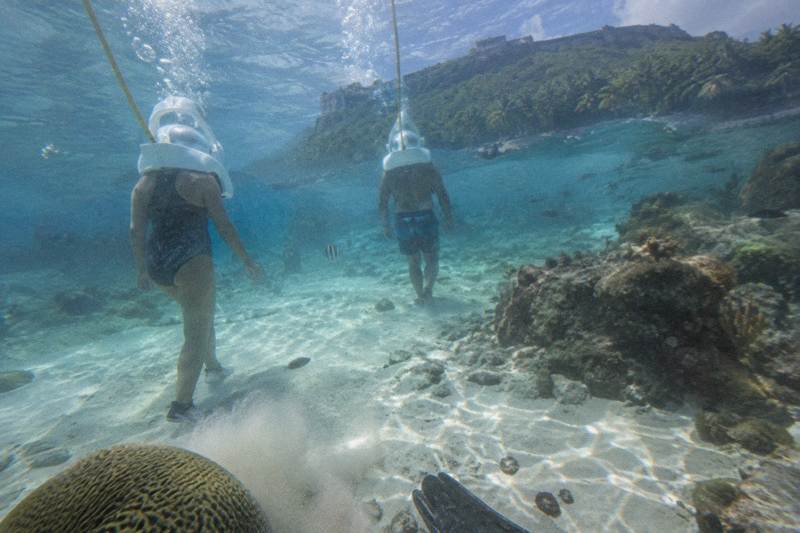
How Heavy Is A Sea Trek Helmet, And Will It Hurt Your Neck?
The manufacturer's underwater weight figure for the Sea Trek helmet, where the load sits, the optional lift buoy, and how the gear compares with SNUBA and snorkeling in St Lucia.
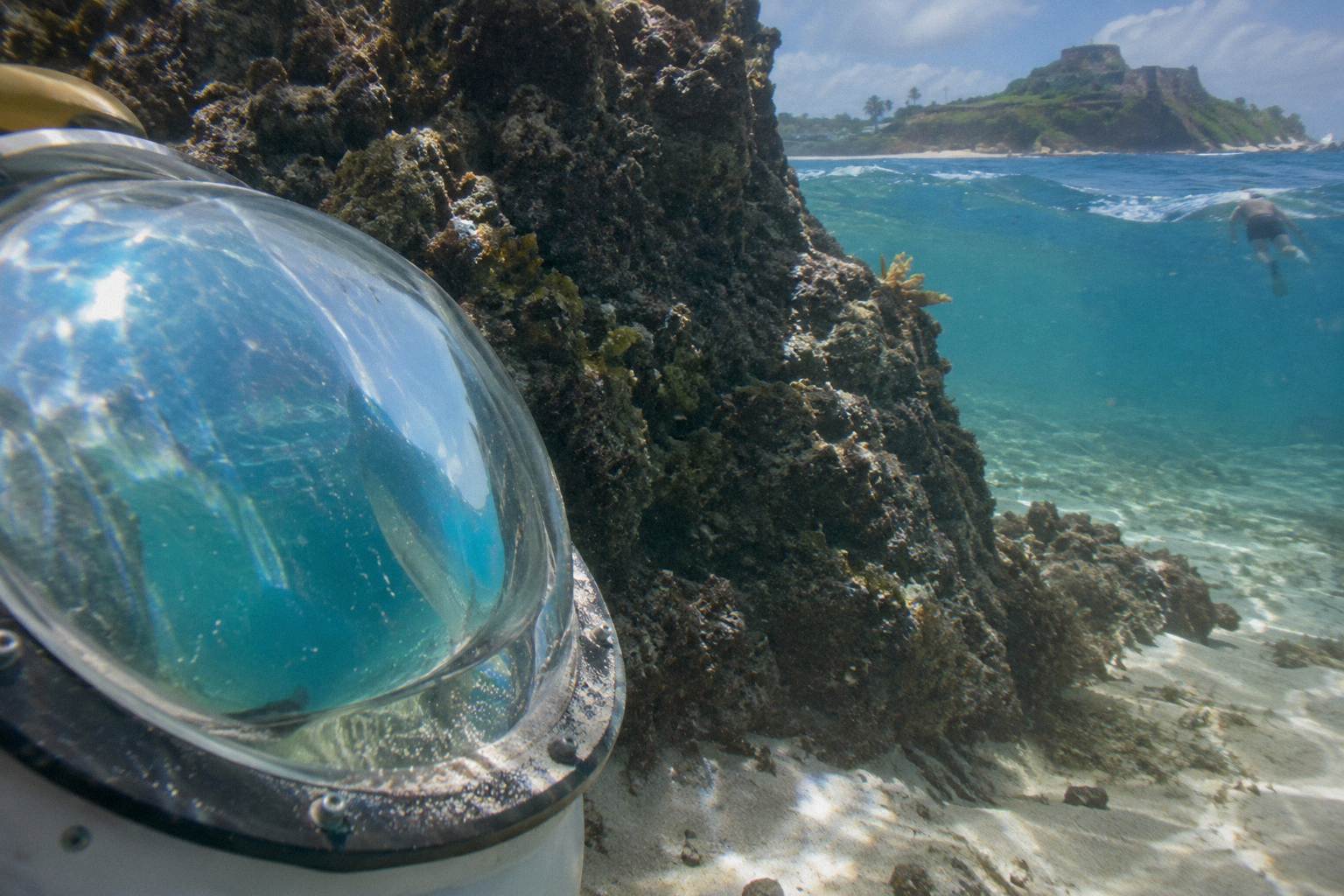
Weight is the question first-time helmet walkers ask more than any other, and it has a precise answer for the underwater side. The beginner underwater tours in St Lucia all solve the same problem, carrying air to your face, in three different ways, and the helmet is the only one that puts the gear on your body rather than in your hand or on your back.
| Fact | Detail |
|---|---|
| Underwater weight | About 15 lb (6.8 kg), the manufacturer's figure, varying slightly with salinity |
| Out-of-water weight | Not published by the manufacturer for guests |
| Where the load sits | The helmet rests on the shoulders |
| Design intent | Low centre of gravity for stability while walking |
| Lift buoy option | Can relieve about 5 lb of the underwater weight, aimed at smaller adults and children |
| Minimum age | 8 |
| Swimming skill | Not required, in the manufacturer's words |
| Main product | SeaTrek St. Lucia, 1 hour 30 minutes, from US$118 per person |
The manufacturer, Sub Sea Systems, gives the Sea Trek helmet an underwater weight of about 15 lb (6.8 kg), varying slightly with the salinity of the water. The helmet rests on the shoulders rather than hanging from the neck, and the manufacturer designed it with a low centre of gravity so it stays stable while you walk. Whether any of that suits your own neck is a question for the operator before you book.
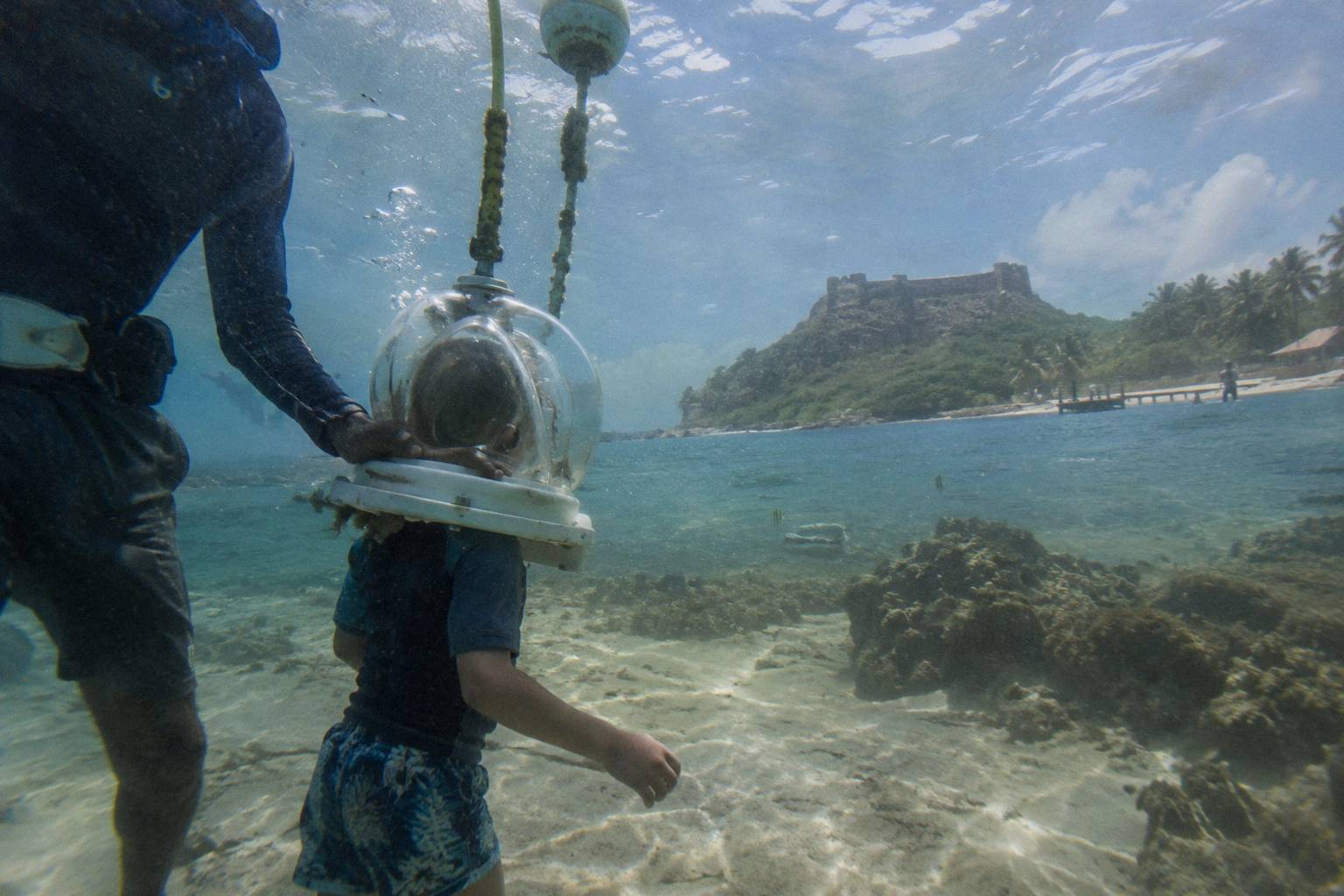
That single figure answers half the question, and it is worth being careful about which half. The number people imagine when they picture a brass diving helmet from an old photograph is the dry weight, the mass you would feel lifting the helmet off a deck. The manufacturer does not publish that figure for guests, and it is not the number that matters underwater anyway. Once the helmet is submerged, buoyancy and the design of the shell bring the felt load down to the manufacturer's stated figure of about 15 lb, and an optional lift buoy on the helmet handle can relieve about 5 lb of even that.
The reason the felt weight stays modest is mechanical. The helmet does not strap to your head and does not clamp onto your neck. It rests on your shoulders, the way a backpack's hip belt transfers load to your hips, and the manufacturer deliberately placed the mass low so the helmet behaves like a steady frame around your head rather than a pendulum above it. A low centre of gravity means that when you lean forward to look at the seabed, the helmet moves with you instead of tipping you further.
No source reports neck strain among participants without pre-existing neck or back conditions, and no operator or manufacturer claims a verdict either way. The manufacturer's own framing is "Experience Near Weightlessness", in the operator Sealife Paradise's wording for its St Lucia product. That is a marketing phrase, attributed as such, but it points at the same design logic: the underwater figure, the shoulder carriage and the optional buoy all push in one direction.
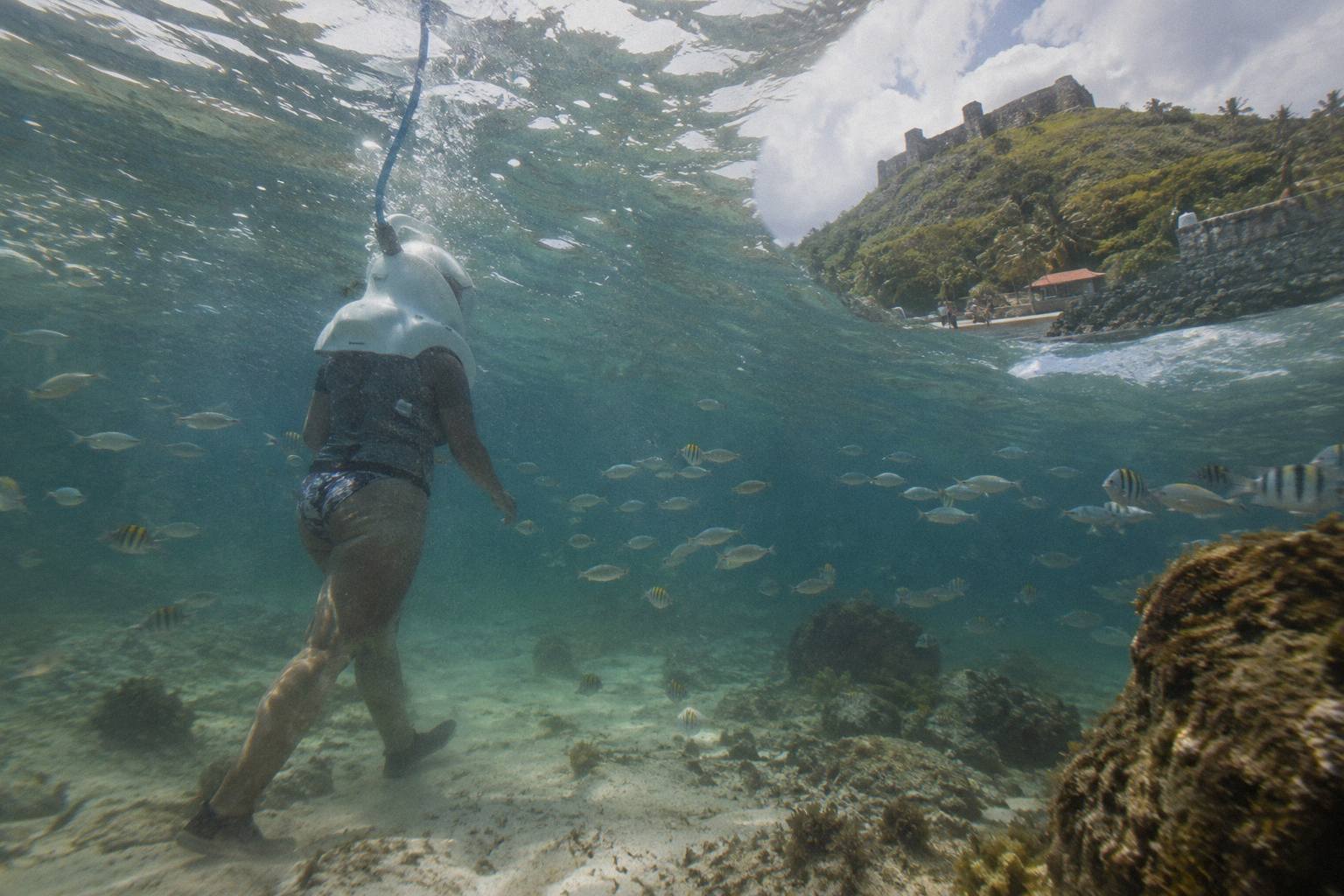
If the weight question is settled, the practical one becomes which format to spend money on, and the three Pigeon Island products cover the full spread of gear carried.
Where The Weight Goes: Shoulders, Not Neck
The helmet sits on the shoulders and stays there for the walk, with nothing gripping the neck. Air arrives through a hose from a surface air centre that supplies a constant flow of cooled, dried and filtered air, so the helmet carries no tank and adds no compressed gas mass to your body. The design carries the load the way a frame pack does, downward through the shoulders.
The air supply is the part that makes the shoulder carriage possible. On the SeaTrek system, the surface side runs an electrically powered air centre, and the helmet receives its air by hose, in the manufacturer's description. Nothing about the breathing loop lives on your back or around your collar. The helmet is polycarbonate and marine-grade components with a panoramic acrylic lens, and the manufacturer describes its principle as similar to an inverted glass: air stays inside as long as the helmet is not turned over, and the constant flow keeps a fresh turnover inside.
That constant flow matters for comfort as much as for breathing. Because fresh air moves through continuously, the helmet does not trap exhaled air, and because the supply is cooled, dried and filtered at the surface, the air inside is treated before it reaches you. Head and face stay dry, in the manufacturer's description, and prescription glasses can stay on, which is one of the small practical differences between a helmet walk and a mask-based format.
Walking, not swimming, is the motion the whole system assumes. "Just walk and breath" is the manufacturer's phrase, and the operator's St Lucia product page repeats the same idea: no swimming needed, ages 8 and up, comfortable walking is the requirement. The weight question and the swimming question turn out to share one answer, because a person standing on the seabed with a shoulder-borne helmet is doing something much closer to a walk in heavy boots than to a dive.
| Helmet Element | What The Manufacturer Says |
|---|---|
| Underwater weight | About 15 lb (6.8 kg), varying slightly with salinity |
| Carriage point | Rests on the shoulders |
| Stability | Low centre of gravity, weighted to sit around the shoulders for stable walking |
| Air principle | Similar to an inverted glass; air stays in unless the helmet is turned over |
| Air supply | By hose from an electrically powered surface air centre, cooled, dried and filtered |
| Materials | Polycarbonate and marine-grade components, panoramic acrylic lens |
| Lift buoy | Optional, on the helmet handle, relieves about 5 lb of underwater weight |
For anyone weighing formats against each other, the question of how the air gets to you splits the field neatly: by hose from the surface, by raft on the surface, or by your own lung power. Full equipment details appear on the manufacturer's SeaTrek page, and the operator Sealife Paradise tours page covers how the same gear is used at Pigeon Island.
The Pigeon Island session itself runs 1 hour 30 minutes in total, with about 10 minutes of briefing and about 25 minutes underwater. If 25 minutes of shoulder-borne walking sounds right, the dates and the per-person price are worth checking early.
What The Lift Buoy Does For Smaller Adults And Kids
An optional lift buoy clips onto the helmet handle and can relieve about 5 lb of the underwater weight, and the manufacturer aimed it at smaller adults and children. That brings the felt figure from about 15 lb down toward about 10 lb, using the manufacturer's own numbers, and it changes nothing about where the helmet sits: the buoy helps the shoulders, not the neck.
The buoy is a small thing worth knowing about before you book rather than after. It is not a different helmet and not a different tour, just an accessory on the handle that offsets part of the underwater weight, in the manufacturer's equipment documentation. For a parent booking for an eight-year-old, the minimum age on the St Lucia product, or for a lighter adult who wants the margin, asking the operator whether the buoy will be fitted for your session is a reasonable question to send in advance. Check with the operator about availability on the day you choose.
The minimum age of 8 comes from the manufacturer's own guidance, which runs from ages 8 up, and the St Lucia product carries the same minimum. Kids who meet the age floor are walking, not swimming, and the guided format means trained and certified guides accompany every tour, in the manufacturer's description. The lift buoy is the manufacturer's answer to the natural follow-up question, whether the smallest participants carry the same felt load as the largest, and the answer is that they do not have to.
What no source supplies is a weight limit, height limit or group size for the helmet session, so print nothing on those and ask the operator directly if one matters to your booking. The one group figure that is published belongs to the other Pigeon Island product: the SNUBA session runs with a maximum of 14 travellers.
Between the shoulder-borne helmet and the buoy option, the weight story is fully told in two numbers. The rest of the decision is about format, and gear carried is the cleanest way to compare them.
How The Helmet Compares With SNUBA And Snorkeling Gear
The helmet is the only one of the three Pigeon Island formats that carries its weight on your body; SNUBA puts the air on a floating raft and hands you a regulator, and snorkeling puts nothing on you at all. The three also split on swimming: the helmet requires none, while both SNUBA sessions in practice and the snorkel products list swimming ability as needed for the water-based formats.
SNUBA, as the operator describes it, is a cross between snorkeling and scuba diving, with no tank and no certification. You breathe through a regulator connected to a floating raft on the surface, so the gear you carry is a mouthpiece and a hose, and the raft does the rest. Compared with the helmet's shoulder-borne 15 lb, SNUBA's carriage is effectively nil, but the trade is that your face is in the water and your mouth holds the regulator. Some people find that freedom; others find the helmet's dry head and face, in the manufacturer's description, the more relaxing arrangement. The wider set of guides lives on St Lucia Helmet Dive.
Snorkeling removes even the hose. A mask, a snorkel and fins are the whole kit, with the beach product at Pigeon Island including the use of snorkelling equipment and bottled water. The offset is the surface: you look down at the reef rather than walking through it, and the Tourism Authority describes Pigeon Island Beach as calm sheltered waters that suit beginners. The sea itself stays between 26 and 29 C (79 to 84 F) all year, with mornings generally the calmest and clearest, which is a planning fact rather than a promise about any particular day.
| Format | Gear On You | Air Comes From | Swimming Needed | Minimum Age |
|---|---|---|---|---|
| Sea Trek helmet walk | Shoulder-borne helmet, about 15 lb underwater | Hose from a surface air centre | No | 8 |
| SNUBA | Regulator and hose | Floating raft on the surface | Water-based, ages 8 and up | 8 |
| Beach snorkeling | Mask, snorkel, fins | Your own lungs | Swimming ability needed | 6 |
The same operator, Sealife Paradise, runs both Pigeon Island products, departing from Pigeon Island in Gros Islet, each 1 hour 30 minutes long, with pickup included from hotels in the north of the island only. The helmet walk is from US$118 per person, rated 4.8 from 231 reviews, and the SNUBA session is from US$112 per person, rated 4.7 from 166 reviews. Amounts are in US dollars, prices vary by date, and the booking page shows the price for the date you choose. Both carry free cancellation up to 24 hours before the start.
For a fuller walk through the trade-offs, the guide on how deep and how long a helmet dive lasts covers the timing side, and whether helmet diving works for non-swimmers takes the swimming question in depth.
Who The Manufacturer Says Can Do It
Ages 8 and up, no swimming skills required, prescription glasses allowed to stay on, and guided by trained and certified guides on every tour: those are the manufacturer's published conditions, and the St Lucia product carries the same age floor. The one medical caution belongs to the operator's booking page, which does not recommend the experience for pregnant travellers, those with poor cardiovascular health, or those with spinal injuries.
That caution is the operator's own advisory, printed on its booking page for both the helmet walk and the SNUBA session, and it is the closest any official source comes to answering the neck question for people with pre-existing conditions. Spinal injuries are named specifically. For anyone with a history of neck or back problems, the routing is simple: ask the operator or a doctor before booking, and do it in writing so the answer is on record. For everyone else, no source offers a verdict, and none is needed to make a decision.
The manufacturer's age range runs wide, from 8 up, and the requirements are deliberately minimal: comfortable walking, in its words, is the physical bar. Guides are trained and certified, every tour is guided, and the operator in St Lucia promises small groups and free transfers within the north of the island. The session at Pigeon Island includes private transportation from northern hotels, with the exact meeting point supplied on the booking confirmation; gratuities are not included, and photos are not among the included items.
One question the manufacturer's material does not address is contact lenses, so say nothing there, and glasses are the documented case. For the weight-adjacent practicalities, the guide on what to wear and bring to a helmet dive is the practical companion, and the risks, limits and who should skip guide takes the medical screening questions further.
The beach snorkel option is the lightest of the three on gear, a mask, snorkel and fins, and at from US$70 per person with equipment and bottled water included it is also the gentlest on the budget, rated 4.4 from 16 reviews. Swimming ability is needed, the minimum age is 6, and pickup is not included, so it suits readers staying near Gros Islet.
What Trips People Up Before You Book
The three recurring mistakes are fixable before payment: assuming the dry weight is what you will feel, booking from a hotel in the south and expecting a transfer, and forgetting that the underwater portion is about 25 minutes of a 1 hour 30 minute product. Each has a one-line fix, and none requires guessing at figures the manufacturer has already published.
The dry-weight mistake comes from the photographs. Vintage diving helmets in museums weigh enough to need a crane, and first-time bookers transfer that image to the Sea Trek shell. The underwater figure is the manufacturer's about 15 lb, the buoy can take about 5 lb of that, and the load rides the shoulders. If a pre-existing neck condition is in the picture, ask the operator before booking rather than after, once, in writing.
The geography mistake is the southern one. Pickup for the Pigeon Island products is included from hotels in the north of the island only, and the exact meeting point arrives on the booking confirmation. Travellers staying in Soufriere, Vieux Fort, Micoud or Dennery should plan their own transport north or pick a product that departs from their coast. The west-coast scuba and boat-snorkel products from Marigot Bay pick up from northern to western locations, but not from the south either.
The timing mistake cuts both ways. Some readers expect a half-day commitment and find the product is 1 hour 30 minutes end to end, about 10 minutes of briefing and about 25 minutes underwater; others expect an hour on the bottom and are surprised by the 25-minute walk. Both are well served by reading the duration line before booking. The fourth small trap is clock times: start times are chosen on the booking calendar, so check the calendar for the day you want rather than assuming a schedule.
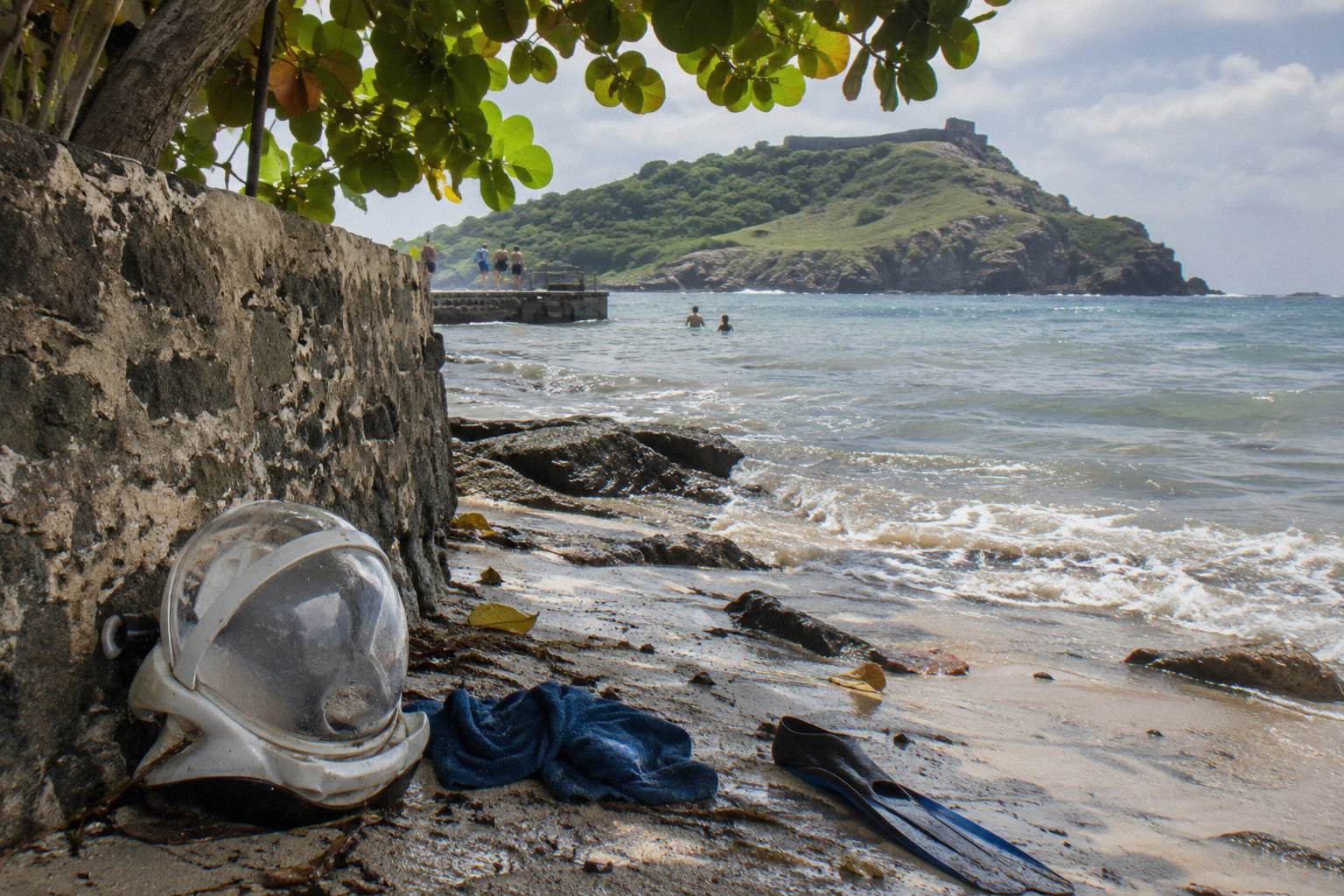
Money has two small traps of its own. Amounts are in US dollars, and the Eastern Caribbean dollar is pegged at EC$2.70 to US$1, with US cash widely accepted and change often given in EC$. Free cancellation runs to 24 hours before the start on the products here, so a date held early can still be moved. The Saint Lucia tourism snorkeling beaches page adds the authority's own beach guidance, reef-safe sunscreen and never touching coral or marine life among it, worth reading before any day at Pigeon Island Beach, and the National Trust's Pigeon Island National Landmark page carries the park's hours, 9:30 am to 5:00 pm with last entry at 4:15 pm, plus its entry fees, which are the Trust's own and are separate from any tour price.
Pigeon Island itself rewards the walk either way: a 44-acre National Landmark since 1992, joined to the mainland by a causeway built in the early 1970s, with Fort Rodney, Signal Peak and a museum on the grounds. More on that is in the guide to getting to Pigeon Island from Rodney Bay, Castries and the cruise ports.
Common Questions About Sea Trek Helmet Weight
How Heavy Is A Sea Trek Helmet, And Will It Hurt Your Neck?
The manufacturer gives about 15 lb (6.8 kg) underwater, varying slightly with salinity. The helmet rests on the shoulders with a low centre of gravity, and no source reports neck strain among participants without pre-existing conditions. If you have a neck or back history, ask the operator before booking.
Can The Underwater Weight Be Reduced?
Yes, by about 5 lb. The manufacturer offers an optional lift buoy that clips onto the helmet handle and relieves roughly that much of the underwater load, aimed at smaller adults and children. Ask the operator about availability for your session.
Does The Helmet Sit On Your Neck Or Your Shoulders?
On the shoulders. The manufacturer describes the helmet as weighted to sit around the shoulders, with a low centre of gravity for stability while walking, and nothing about the design grips or hangs from the neck.
How Heavy Does It Feel Out Of The Water?
The manufacturer does not publish the out-of-water weight for guests, and no estimate is offered here. The felt figure underwater is the manufacturer's about 15 lb, and the walk begins once the helmet is submerged and the buoyancy is doing its work.
Can Children Carry The Helmet?
The minimum age is 8, and the manufacturer's guidance runs from ages 8 up. The optional lift buoy, which relieves about 5 lb of underwater weight, was designed partly with children and smaller adults in mind, so raise it with the operator when booking for a child.
Do You Need To Be Strong Or A Swimmer For The Helmet Walk?
No swimming skills are required, in the manufacturer's words, and the physical requirement is comfortable walking. The walk on the seabed lasts about 25 minutes of the 1 hour 30 minute product, guided throughout by trained and certified guides.